In June 2024, an 81-year-old president walked onto a debate stage and quickly demonstrated that he was certainly not fit for reelection. I recall watching the debate and wondering if he should even be allowed to finish his term. Biden seemed like a different man from the one we saw in 2020.
President Joe Biden trailed off and gave answers that didn’t make sense, and within weeks, he was out of the race. Clearly, the country wasn’t concerned with age as Donald Trump was elected that fall as the oldest presidential nominee in American history.
It’s important to note that we’ve had older presidents before. Ronald Reagan took office at 69, the oldest president at the time. Nearly six years after leaving office, he told the country he had Alzheimer’s, something I was reminded about recently while reading Max Boot’s Reagan: His Life and Legend. Whether the disease was already at work in the Oval Office is still argued: his son Ron suggested his father showed early signs in the White House, while the doctors who treated him said they never saw any indication of dementia.
And it isn’t just presidents. Federal judges serve for life with no mandatory retirement age. Judge Pauline Newman, a Reagan appointee who has sat on the Federal Circuit since 1984, was suspended by her colleagues in 2023 over concerns about her fitness. In June of this year, the Supreme Court declined to hear her appeal. She’s now 99.
I’m not really here to argue about lifetime judicial appointments, and frankly, I’m generally in favor of isolating judges from the hubbub of our active political cycles. But my primary question is this: if we did have term limits and/or age limits for Congress, judges and presidents, would anything have changed?
The answer is clearly yes.
My proposal
I had a simple idea for term limits:
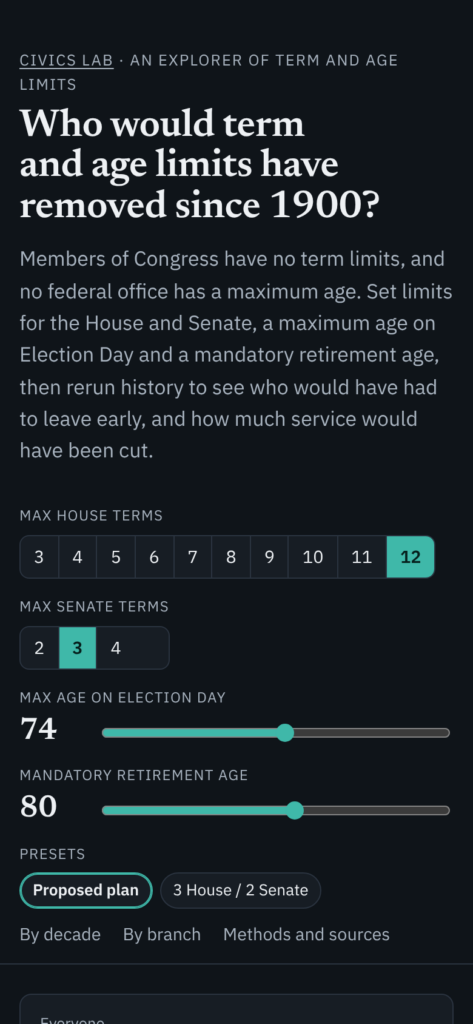
- Senate: 3 terms, or 18 years.
- House: 12 terms, or 24 years.
- Maximum age on Election Day: 74.
- Mandatory retirement at 80 for everyone (Congress, the president and federal judges).
I’m sympathetic to ideas that say people should be given broad latitude to select their elected officials. To me, longer limits of this nature provide the electorate freedom to choose their preferred candidate while merely trimming the electoral outliers. Other proposals I’ve seen suggest shorter limits. A more recent one I saw had the House at 3 terms and the Senate at 2. My logic, again, is different: the president gets 8 years and holds a whole branch of government. A senator is 1 of 100, and a House member is 1 of 435. Less power per person should mean more time in office.
That makes this mostly an age proposal, with term limits as a backstop.
(Yes, I know this requires a constitutional amendment. It’s just a website exploring an idea! Yes, I know that states tried to term-limit their own members of Congress in the 1990s, and the Supreme Court struck those laws down. And then there’s the question of limits for judges, something that would likewise require an amendment.)
Who it would have removed
So I used Claude to build a tool to find out.
The Term Limits Simulator on my Civics Lab tool takes every voting member of Congress, every president and every federal judge who has served since 1900, applies rules you select, and reruns history.
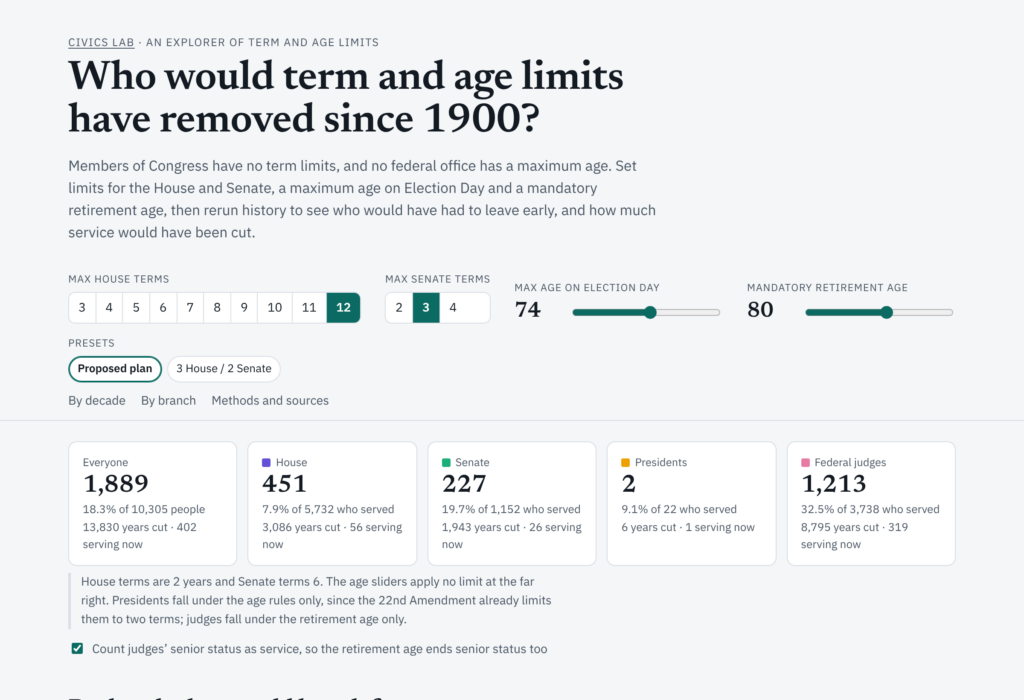
Under my plan, 1,889 of 10,305 officials would have had to leave early. That’s about 18%, and about 13,800 years of service cut. It strikes me as a good starting point!
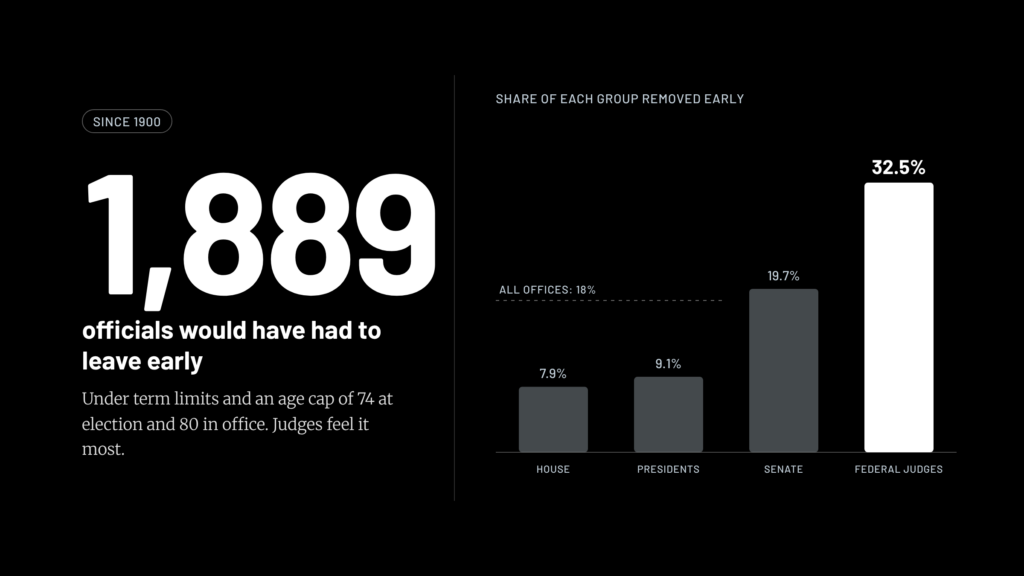
| Group | Would have left early | Share of all who served | Serving now who’d be out |
|---|---|---|---|
| House | 451 | 7.9% | 56 |
| Senate | 227 | 19.7% | 26 |
| Presidents | 2 | 9.1% | 1 |
| Federal judges | 1,213 | 32.5% | 319 |
A few interesting tidbits:
- A third of all federal judges since 1900 would have hit the retirement age while still on the bench. Most of the 319 sitting judges who’d be out today are on senior status, a kind of semi-retirement where judges still hear cases.
- One in five senators since 1900 served more than 18 years. More would be affected by term limits than age.
- Biden was 77 when he won in 2020 and Trump was 78 when he won in 2024, so the 74 cap catches both. Reagan was 73 at his 1984 win and left office at 77, so he’d have been fine.
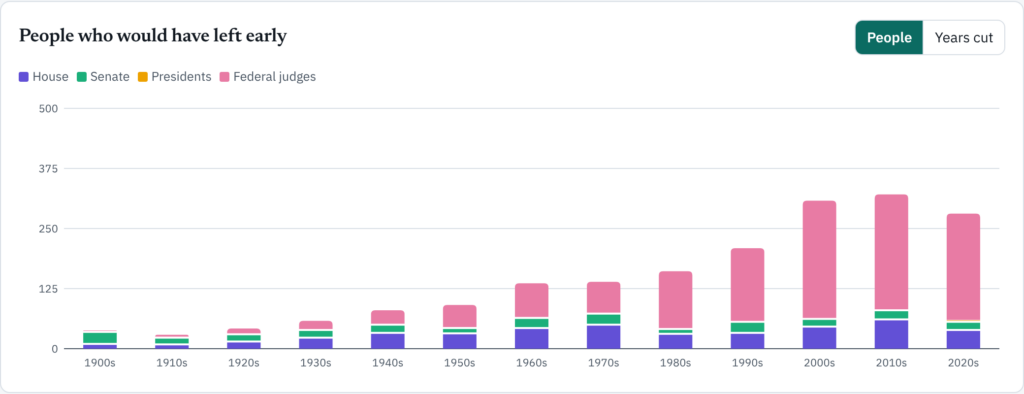
For comparison, a more restrictive 3-term House limit would have pushed out more than half of everyone who served in the House since 1900. This seems unrealistic and far too short!
We’ve done this before
While difficult, I’d like to remind folks that we have actually amended the Constitution before, and it came out of a moment when folks were unhappy with a politician’s length of term in office. After Franklin Roosevelt won four elections and died months into his fourth term, Congress proposed the 22nd Amendment in 1947. Republicans controlled Congress, but it passed with help from Southern Democrats, and Truman went along, and Minnesota became the 36th state to ratify it in February 1951.
The public already thinks that politicians are serving too long and too late into life. An NPR/PBS News/Marist poll this spring found that 8 in 10 Americans backed both age caps and term limits. Support for an age cap crossed party lines: 78% of Democrats, 83% of Republicans and 79% of independents. Older voters were just as supportive as younger ones.
How often does that happen anymore? I would suspect only one group of Americans would be widely opposed: elected officials themselves!
Arguments against
Today, I’m in favor of age and term limits, but some disagree for some logical reasons:
- If someone’s too old, vote them out of office. The Constitution already sets minimum ages for every federal office, so this a change by degree.
- Research on state legislatures finds term limits shift power toward interest groups, and lawmakers in their final term do less for constituents. That’s why my limits are long: 18 and 24 years, not 6 and 12.
- Life tenure is meant to keep judges independent. A retirement age at 80 means a judge would have decades on the bench. I suspect, though, that older judges would be passed over for higher courts to a greater degree than what we see today.
- Amending the Constitution takes two-thirds of Congress and three-quarters of the states. That’s a tall order to ask members of Congress to limit themselves, something I don’t get the sense they like doing! But hard doesn’t mean we should punt on the issue.
How I built it (from the bleachers)
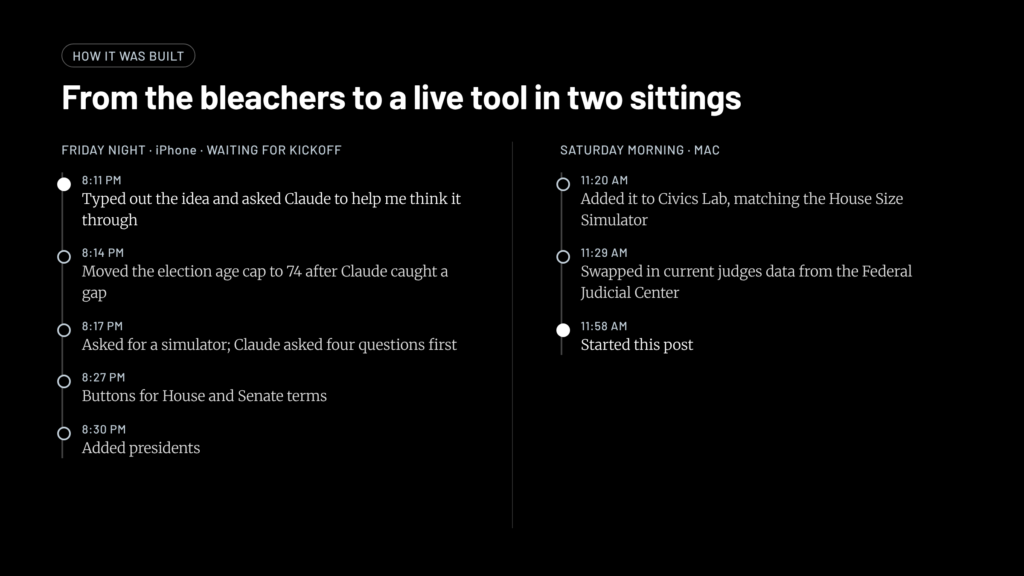
This started on my iPhone on a Friday night, while I waited for a Texas high school football championship game to kick off. (I learned later that it was Joe Biden’s 84th birthday!) By the next morning it was a live tool on my Civics Lab site.
Here’s how it went, all in Claude.
1. Thinking it through. I typed out my rough idea and asked Claude to help me think about the shortcomings. It found a hole right away: I started with a max election age of 75 but an 80-year age limit, something that would be a mess for 6-year senatorial terms. But Claude wasn’t perfect: it claimed a 20-year committee chair could have more say over a policy area than the president. I called that nonsense. A helpful reminder: Claude is a good research assistant and programmer, but some degree of knowledge remains a key precursor for successful AI use. Claude, as it does in these situations, agreed it had overstated things and narrowed the point.
2. Asking questions first. When I asked for an interactive projection, I told Claude to ask questions before building. It asked which judges to include, what “affected” should measure, and which age controls I wanted. I picked all federal judges, headcounts and years of service cut, broken out by decade and by branch.
3. Finding the data. Claude pulled every member’s terms and birth date from the congress-legislators project on GitHub. The Federal Judicial Center’s site was blocked from its workspace, so it used an older 2014 copy of the judges data and flagged that on the page. I fixed this later in the process.
4. Checking the math. The simulator runs in JavaScript in your browser. Claude also wrote a separate Python version and compared results for several settings. They matched.
5. Tweaking from my phone. I asked for buttons instead of sliders for terms (2 to 4 for the Senate, 3 to 12 for the House), then asked it to add presidents. Each change took a minute or two.
6. Fixing the judges. I downloaded the current judges file from the Federal Judicial Center’s directory and uploaded it to Claude. The judge count under my plan jumped from 878 to 1,213, because the old data was missing the last 12 years.
7. Moving it to Civics Lab. Saturday morning, on my Mac, I asked Claude to add it to Civics Lab. It read how the House Size Simulator was built, copied that structure, matched the look, wrote tests and added the listing to the home page. I ran a command to deploy.

My first message went out at 8:11 p.m. Friday, and my last tweak that night came about 20 minutes later. Saturday’s work took less than an hour.
Try it yourself
The Term Limits Simulator is live on Civics Lab, along with the methods and sources.
Sources
- NPR/PBS News/Marist poll on age caps and term limits, May 2026
- National Archives on the 22nd Amendment
- National Constitution Center on how the 22nd Amendment was ratified
- Coverage of the Supreme Court declining Judge Newman’s appeal
- Fact check on whether Reagan had Alzheimer’s in office
- Congress member terms and birthdays from the congress-legislators project
- The Federal Judicial Center’s biographical directory of federal judges