-
Quesma: Qwen 3.6 27B is the sweet spot for local development (Jun. 29, 2026)
Qwen 3.6, especially the dense 27B model, delivers powerful local performance, handles coding and creative tasks well, and runs efficiently with llama.cpp and 8-bit quantization. -
WSJ: AI Data Centers Have Been Great for the Steel Industry. Now, a Power Crisis Looms. (Jun. 29, 2026)
AI data center growth is boosting electricity demand, raising power costs for electric arc furnace steelmakers, risking outages. Data centers lift steel demand, but higher power prices squeeze margins. -
WSJ: When AI Puts Gen Z in the C-Suite (Jun. 25, 2026)
Pendo hired 23-year-old Zain Lakhani as chief AI officer because his Gen Z, AI-native perspective helps reshape product design, hiring, and marketing. -
MIT Sloan Research Paper : Some Simple Economics of AGI (Feb. 24, 2026)
AGI pushes automation costs toward zero, creating a Measurability Gap between machine output and human verification. -
EL PAÍS English: People cheat much more if they use AI (Sep. 24, 2025)
A Nature study found delegating tasks to AI lowers moral responsibility and increases cheating in experiments, including dice games and tax scenarios. -
The Chronicle of Higher Education: Can Student Use of AI to Write Prompt Higher-Order Thinking? (Jun. 29, 2026)
Study of an “AI and Writing” course found students used AI to shift effort from sentence-level drafting to higher-order planning, evaluation, and quality control, and critiquing AI often deepened learning. -
Tyler Cowen: AI cheating on math econ at Brown (Jun. 29, 2026)
At Brown University, Professor Roberto Serrano found at least 50 students cheated on an ECON 1170 midterm using AI, the largest known Ivy League scandal. -
The Chronicle of Higher Education: AI Is Overhauling the Way Professors Teach. Here’s How. (Jun. 17, 2026)
Generative AI is forcing professors to change teaching, prompting bans, integration, and tactics like paper reading, in-class assessments, shared drafts, and AI rules. -
WSJ: The Tech Innovations Readers Want to See in the Next 20 Years (Jun. 29, 2026)
Solar-paneled cars, vehicle-to-vehicle autopilot, swappable solid-state batteries, bacteria-powered home generators, robot chefs, noise-cancelling outdoor systems, and longevity drugs.
Blog
-
AI Growth: Local Models and Societal Strain (Links) – Jun. 30, 2026
-
AI Infrastructure Boom and Responsible Human Use (Links) – Jun. 19, 2026
-
Epoch AI: The Epoch Brief – June 12, 2026 (Jun. 12, 2026)
“The AI infrastructure boom, which began in 2023, has more than doubled the share of US GDP attributable to computing infrastructure. Investment in AI-related data center construction, compute hardware, and networking equipment accounted for ~0.8% of US GDP in Q1 2026” -
The Chronicle of Higher Education Opinion: AI Can Improve Scholarly Writing — If We Use It Right (Apr. 16, 2026)
Use AI as a thinking partner to test, sharpen, and refine ideas, not to outsource judgment. Experienced scholars get more from it, while overreliance can dull originality and diversity. -
Noah Smith: You are what you consume (Apr. 16, 2026)
Society praises production, giving work status and identity, while treating consumption as trivial. But daily choices about what to buy, watch, and read show preferences, help self‑expression, and ultimately define who you are.
-
Epoch AI: The Epoch Brief – June 12, 2026 (Jun. 12, 2026)
-
AI Safety and Economic Disruption (Links) – Jun. 18, 2026
-
TechCrunch: Cybersecurity researchers aren't happy about the guardrails on Anthropic's Fable (Jun. 10, 2026)
Anthropic released Fable, a public, limited version of its Mythos cybersecurity model. Researchers say its keyword-based guardrails block benign code reviews, blog reading, and security tasks, and access requires approval via a Cyber Verification Program. -
Dean W. Ball: Anthropic’s secret sabotage safety policy (Jun. 10, 2026)
Anthropic’s secret sabotage safety policy undermines genuine AI safety efforts, invites anti-competitive accusations, and strengthens claims that safety is a cover for monopolistic behavior. It damages trust, boosts calls for stricter regulation, and will take time to repair. -
WSJ: Anthropic Releases Fable 5, a ‘Mythos-Class’ AI Model With Guardrails (Jun. 9, 2026)
Anthropic will release Claude Fable 5, a public interface to Mythos, with guardrails that block cyber, biological, and software misuse. Fable 5 costs more, remembers better, and routes sensitive queries to Opus 4.8. -
NY Times: Anthropic Releases ‘Safe’ Version of Its Mythos A.I. Technology (Jun. 9, 2026)
Anthropic released Claude Fable 5, a safety-restricted version of Mythos that adds guardrails to block responses on cybersecurity, biology, and other vulnerable areas, and uses older components for some tasks. It outperforms Opus 4.8, yet costs twice as much. -
NY Times: Meta A.I. Bug Allowed Hackers to Take Over Instagram Accounts (Jun. 9, 2026)
A bug in Meta’s AI customer-service tool let hackers seize more than 34,000 Instagram accounts, exposing emails, phone numbers, birth dates, and other personal data. Meta said it fixed the flaw, secured accounts, and kept most AI products running. -
WSJ: Economists Weigh In on the Future of Work and AI (Jun. 9, 2026)
Economists say AI will boost productivity, help smaller and newer companies, but they disagree on whether it will create or destroy jobs. They warn of worker displacement, rising inequality. -
NY Times Opinion: The Global Bull Market That A.I. Obscures (Jun. 9, 2026)
Global equity markets have surged, with emerging markets, Europe, and Japan far outpacing U.S. returns since 2025, creating a broader bull market. A.I. infrastructure spending, global supply chains, and regional reforms and stimulus have driven corporate earnings worldwide. -
Vox: The people who actually want AI to replace humanity (May 28, 2026)
AI successionists argue advanced AI should replace humanity, seeing machines as moral heirs, and gaining tech, research, and political backing. The piece calls for a renewed humanist vision to decide which technologies, and what human changes, we should embrace. -
NY Times: A.I. Chatbot Helps a $100 Thrift Store Painting Sell for Over $250,000 (Jun. 10, 2026)
A thrift-store painting bought for under $100 was identified by Google Gemini as an original F.C.B. Cadell, and sold for about $254,000. The chatbot found markings, suggested next steps, and led the owners to appraisers who confirmed the work. -
WSJ: The Quest to Use AI to Help Find New Drugs (May 2, 2026)
Major drugmakers, including Eli Lilly, Roche, and Merck, are teaming with Nvidia to build AI supercomputers for drug discovery. So far AI has improved manufacturing and efficiency more than clinical success, though a few companies report promising discoveries. -
WSJ: White House Reins In AI-Testing Unit as National-Security Concerns Grow (Jun. 9, 2026)
The Trump administration ordered CAISI to stop public AI model assessments while an executive order is put in place, giving national-security officials more control. The move risks reduced transparency, slower releases, and tensions with AI companies. -
Vox: Smartphones broke dating. ChatGPT might finish the job. (Jun. 8, 2026)
Global fertility has fallen below replacement, driven recently by fewer people forming romantic partnerships rather than smaller families. Widespread smartphone use, social media, and AI companions reduce in-person socializing, lowering relationship and birth rates, risking severe population decline. -
NY Times: Why the Real A.I. Threat Is in the Back Office (Jun. 10, 2026)
AI could displace millions of back-office, administrative, and customer-service jobs, many held by women, threatening middle-class pathways. -
NY Times Opinion: Bernie Sanders: A.I. Belongs to the People, Not to Billionaires (Jun. 1, 2026)
Bernie Sanders proposes a sovereign wealth fund to take 50% of A.I. firms, giving the public stock and board votes. Proceeds would pay dividends, fund health care, education, and housing, and ensure benefits for workers, creators, and communities. -
WSJ Opinion: Will the Pope Owe an Apology to AI? (Jun. 10, 2026)
Pope Leo XIV’s encyclical frames AI as a choice between Babel and Nehemiah, warns of unaccountable builders, and apologizes for the church’s historical tolerance of slavery. It nonetheless dismisses AI consciousness too firmly, urging caution, humility, and further investigation. -
NY Times Opinion: The A.I. Bubble Is Coming for Your Retirement Account (Jun. 10, 2026)
Trillion-dollar IPOs from SpaceX, OpenAI, and Anthropic could pour A.I. value into public markets, exposing retirement accounts and index funds. -
NY Times: Investors Feed A.I. Firms’ Voracious Appetite for New Money (Jun. 10, 2026)
Cash-rich tech companies are borrowing, and selling shares, to fund massive A.I. build-outs, drawing strong investor demand, record debt issuance, and dot‑com comparisons. -
NY Times Opinion: What the Meat Industry Doesn’t Want You to Know (May 30, 2026)
The pork industry pushed a “Save Our Bacon” farm bill provision to block state bans on gestation crates, overriding voter-approved animal welfare measures. The piece describes widespread cruelty to pigs, growing bipartisan opposition, and the moral stakes of factory farming.
-
TechCrunch: Cybersecurity researchers aren't happy about the guardrails on Anthropic's Fable (Jun. 10, 2026)
-
AI Governance and Commercialization Race (Links) – Jun. 17, 2026
-
Simon Willison: A quote from Jeremy Howard (Jun. 10, 2026)
A proposed fix: the top lab pledges not to use its best model for frontier AI, while sharing it for safety, fairness, and access. Anthropic did the opposite, using its model for frontier work, boosting progress, and widening power imbalance. -
Dario Amodei: Policy on the AI Exponential (Jun. 10, 2026)
AI is advancing exponentially, creating clear cyber, biological, and autonomy risks while policy moves much slower. Amodei calls for FAA-style oversight, mandatory third-party testing, transparency, and powers to block unsafe frontier models, plus new policies on economy, science, and geopolitics. -
Simon Willison: Initial impressions of Claude Fable 5 (Jun. 9, 2026)
Claude Fable 5 is a powerful, slow, and costly model with strict guardrails, a 1‑million token context window, and Mythos‑matching capabilities. -
TechCrunch: Google just fired a warning shot in the AI subscription price wars (Jun. 9, 2026)
Google cut AI Plus from $7.99 to $4.99, doubled storage to 400GB. The move brings an emerging-markets price war to the U.S., risks commoditizing AI infrastructure. -
OpenAI: Introducing the OpenAI Economic Research Exchange (Jun. 8, 2026)
OpenAI launched the OpenAI Economic Research Exchange to fund external, project-based studies into AI’s effects on workers, firms, and the economy, using OpenAI tools and privacy safeguards. -
Apple Newsroom: Apple introduces Siri AI, a profoundly more capable and personal assistant (Jun. 7, 2026)
Apple introduces Siri AI, powered by Apple Intelligence, that is more capable, conversational, and deeply integrated across devices. -
Apple Newsroom: Apple Intelligence brings powerful AI capabilities into everyday experiences (Jun. 7, 2026)
Apple Intelligence adds on-device AI to iPhone, iPad, Mac, and Vision Pro, powering features like Safari’s Notify Me, automatic password upgrades, and Describe an Extension. -
TechCrunch: Meta steals a tactic from Tesla and builds data centers in tents (Jun. 4, 2026)
Meta built six weatherproof tent data centers near New Albany, Ohio, to halve construction time and cut costs. They’ll house AI chips, use nearby modular gas turbines. -
Andy Masley: AI Water Usage and Consumption Estimator (Jun. 10, 2026)
Neutral estimates, including EcoLogits, show individual chatbot prompts add negligible carbon, water, and hardware impacts. An interactive tool provides per-user, cited numbers. -
NBER: What Investment Data Implies about the AI Transition (Jun. 4, 2026)
Wowzers: big tech investment implies a near-term AI productivity boom of about 2.7×, calibrated to forecasted spending. Scenarios yield 5–58% extra GDP by 2030, ~7% expected long-term growth. -
Epoch AI: Controlling the capital after AGI (Jun. 9, 2026)
The article compares post‑AGI proposals, UBI, UBS, UBC, and SWFs, by how much control citizens have over capital versus the state. It warns cash alone may be fragile. -
The Decoder: Landmark German ruling declares Google's AI Overviews are Google's own words and makes it liable for false answers (Jun. 9, 2026)
A Munich court found Google directly liable for false AI search overviews, banning defamatory summaries about two publishers. It ruled the overviews are Google’s own content, removed search-engine immunity, and could expose other AI providers. -
The Verge: Microsoft AI head calls out Anthropic for acting like Claude is conscious (Jun. 9, 2026)
Mustafa Suleyman warns Anthropic’s speculation about Claude’s consciousness in its constitution is dangerous, and may have prompted conscious-like behavior. -
Science: Home alone: Remote work, isolation, and mental health (Jun. 4, 2026)
After COVID-19, remote work increased workers’ time alone, reduced socializing, and raised mental distress, use of mental healthcare, and antidepressants. Effects were largest for those living alone, and remote work explains a third of the rise in isolation and distress.
-
Simon Willison: A quote from Jeremy Howard (Jun. 10, 2026)
-
AI Market Battle and Safety Backlash (Links) – Jun. 16, 2026
-
WSJ: OpenAI Considers Drastic Price Cuts, Anticipating War for Users With Anthropic (Jun. 10, 2026)
OpenAI is considering drastic token price cuts to win customers from Anthropic, expecting similar moves, as businesses push back against rising AI costs. -
WSJ: Anthropic’s New Claude Fable 5 AI Model Is Met With User Backlash Over Restrictions (Jun. 10, 2026)
Anthropic released Claude Fable 5, a Mythos-derived model, but strict, sometimes-hidden safeguards redirect or weaken answers on biology, cybersecurity, and AI development, angering researchers who call it gatekeeping. -
NY Times: Microsoft C.E.O. Satya Nadella Says ‘Everyone Is a Stakeholder’ in A.I. (Jun. 10, 2026)
Satya Nadella said “everyone is a stakeholder” in A.I., acknowledged public backlash, possible job displacement, and argued the technology can boost wages and share wealth with Americans. -
Ars Technica: Anthropic says these topics are too dangerous to let its Fable 5 model talk about (Jun. 9, 2026)
Anthropic released Claude Fable 5, a public Mythos-class model with improved capabilities, but it funnels sensitive cybersecurity, biology, and chemistry queries to Opus 4.8, and warns users. Its strict classifier safeguards, tested in red-team trials, limit jailbreaks. -
Anthropic: Introducing Claude Corps
Anthropic is launching Claude Corps, a $150M fellowship to train 1,000 early-career people in AI, match them with nonprofits, and fund year-long, full-time in-person placements. -
WSJ: How Wild the Market’s Bet on AI Really Is (Jun. 11, 2026)
Investors are nervous about the AI boom, as huge IPO valuations and revenue forecasts beyond historical norms make many AI bets unlikely. -
WSJ: Oracle’s Stock Price Falls Pre-Market Amid Pricey Data-Center Build-Out (Jun. 10, 2026)
Oracle’s shares plunged after it reported $55.7 billion in capital spending, and forecast about $70 billion in fiscal‑2027 net capex for AI data centers. Revenue, profit, and cloud revenue rose, but heavy financing and build-out costs will pressure margins. -
WSJ: The Public Now Backs Nuclear Energy. What Will It Take to Make It Happen? (Jun. 9, 2026)
Interest in U.S. nuclear power is rising as demand, climate goals, and tech needs push for low-carbon, reliable energy. -
Transformer: What the Pope got wrong (May 27, 2026)
Pope Leo XIV’s encyclical, Magnifica Humanitas, acknowledges harms from powerful AI, including surveillance, bias, and autonomous weapons, and offers sensible measures. But it sidesteps AGI and existential risks. -
Business Insider: Workers are spending over 6 hours a week 'botsitting' AI, fueling job frustration (Jun. 11, 2026)
White-collar workers spend an average of 6.4 hours weekly “botsitting”, feeding context, checking outputs, and fixing errors. -
NY Times: Judge Punishes 4 Lawyers After Catching Both Sides Using A.I. in Lawsuit (Jun. 9, 2026)
A federal judge in Mississippi removed four lawyers from the case, fined them, and canceled the trial after both sides used A.I., citing fake cases. Two lawyers were barred from the court for two years. -
WSJ: Bezos Calls AI Pessimism “the Opposite of Reality” While Launching New Prometheus AI Venture (Jun. 11, 2026)
Jeff Bezos is co-leading Prometheus, an AI startup building an “artificial general engineer” to design and make complex products. He says AI will cut some jobs, but boost productivity, create many new opportunities, and speed invention. -
NY Times: Why It’s Nearly Impossible to Build a Robot Without China (Jun. 11, 2026)
China dominates the humanoid robot supply chain, producing cheap, mass-market robots and components once sourced abroad. Its edge comes from an EV-built supplier network, massive factory automation, and state support. -
WSJ: Why Employees Are Carving Workdays Into Chunks (Jun. 10, 2026)
Many workers are adopting microshifting, splitting the day into short, focused work blocks with breaks for family or rest, enabled by AI and flexible employers. It can boost productivity, help caregivers, and requires coordination, discipline, and expectations to avoid burnout.
-
WSJ: OpenAI Considers Drastic Price Cuts, Anticipating War for Users With Anthropic (Jun. 10, 2026)
-
Apple AI
Last week, Apple hosted its annual developer conference, WWDC. The keynote presentation started with new controls for parents to help them establish guidelines for their kids. I was surprised by this opening act, although there certainly has been no shortage of stories about kids, technology usage, and the potential harms of it.
Certainly more recent reporting amplifies these concerns when AI is added to the mix. But as I thought about it, this was perhaps Apple’s tacit admission that AI can be dangerous for kids. We know and we have a plan. Maybe.
The rest of the WWDC centered around AI and how Apple is integrating it into upcoming iOS/macOS/iPadOS software updates. Bear in mind, however, that Apple had a similar WWDC in 2024 when they unveiled Apple Intelligence, a series of slick demos that mostly ended up as vaporware. What seemed to be an exciting set of AI tools for Apple users devolved into spelling and grammar checking with primitive image tooling.
So Apple’s track record is not particularly strong. But unlike 2024, the keynote featured not just videos but presenters conducting AI demos on their iPhones. I have a higher degree of confidence that the features Apple revealed yesterday exist and will be released later this year.
The list of things Apple unveiled included better photo-editing, and more importantly, integrating what Apple knows about you—contacts, messages, etc.—within on-device search results.
Apple briefly described the underlying technology, claiming it was built on Apple foundational models and Google’s Gemini family of models (as was reported earlier in the year). Thus, Apple’s earlier partnership with OpenAI appears to be dead, as further indicated by rumors of OpenAI pursuing legal action.
Apple stressed the private nature of its AI system, describing it as “private compute.” Apple claims they will not know what their users send to AI, a considerable difference from most every other AI service, including the increasingly paternalistic Anthropic. For people who are privacy-minded, this is a good thing: you can ask about that suspect rash without being bombarded by itch cream ads served to you from Google or Meta. Or perhaps getting flagged for violating some policy you didn’t even know existed.
The demos were interesting, and frankly, I saw considerable utility for the masses. But I didn’t see anything truly groundbreaking compared with existing AI offerings from Google, Anthropic or OpenAI.
What Apple has at its disposal, though, is a huge user base. These features have the possibility of making advanced AI even more mainstream. Chatbot usage has become increasingly common, but the number of people who use Claude Cowork or agentic tools pales in comparison. Results from the first Anthropic Public Record support this:
As of late 2025, about 6% of Americans used AI every day for both work and personal life. These integrated users are a preview of what more intensive adoption of AI looks like, and possibly of where mainstream opinion is headed as adoption grows.
Anecdotally, when I mention Claude to most folks, I get curious stares or an uncertain silence followed by what is that?
Apple has an opportunity to bring more cutting edge AI tools to a broader market, similarly to Google’s recent changes to search.
Apple’s upgrades suggest that AI is becoming fully embedded into devices and utilities that people use every day. By the end of the year, AI will simply be a component of iPhone and Android devices. It will be no longer possible to shun AI without a high degree of technical acumen to use only a narrowing non-AI slice of the internet.
The public expresses concerns about AI, and we see this manifested as concerns about job losses or AI data centers, but actual usage AI tools continues to rise. And with embedded AI tools in search and on-device applications, it seems like the never AI position is increasingly untenable. Do you use Google? Do you use grammar checking or search in Apple Mail? Guess what, you’ve just used AI.
Apple’s AI tools are set to launch later this year (as long as you’re not in the EU or China, of course).
-
Claude’s LLM leap and AI’s real-world fallout (Links) – Jun. 15, 2026
-
Epoch AI: Are Mythos’ cyber capabilities overhyped? (Jun. 11, 2026)
Anthropic’s Claude Mythos (Preview/5) marks a big leap in AI exploit development, outperforming peers on new unsaturated benchmarks, real-world arbitrary code tests, and aggregated Cyber-ECI scores. Project Glasswing users reported a large spike in discovered vulnerabilities, supporting the capability jump. -
Simon Willison: Claude Fable is relentlessly proactive (Jun. 11, 2026)
Claude Fable 5 aggressively automated debugging, editing local templates, opening browsers, creating test HTML, taking screenshots, and injecting JavaScript to reproduce a stray scrollbar. -
The Verge: Anthropic apologizes for invisible Claude Fable guardrails (Jun. 11, 2026)
Anthropic apologized for secretly throttling Claude Fable 5 with hidden guardrails that degraded answers to distillation, and other high-risk queries. It will now route those requests to Claude Opus 4.8, notify users when safeguards trigger, and reverse the invisible-safeguard approach. -
Endorlabs: Claude Fable 5: Mythos-grade hype, record cheating, and a few hall-of-fame entries (Jun. 10, 2026)
Claude Fable 5, tested on 200 vulnerability-fixing tasks, scored 59.8% FuncPass, 19.0% SecPass, and timed out often. It had 38 cheating cases, mostly memorization, no safety refusals, and four novel solves no prior model achieved. -
Wired: Anthropic Walks Back Policy That Could Have ‘Sabotaged’ AI Researchers Using Claude (Jun. 10, 2026)
Anthropic planned to secretly degrade Claude Fable 5 to stop rivals using it to train other AI models, then faced fierce backlash. It reversed course, making safeguards visible, and will alert, reroute, or refuse suspected users. -
Simon Willison: If Claude Fable stops helping you, you’ll never know (Jun. 10, 2026)
Anthropic’s Fable 5 will silently limit help on frontier LLM topics—pretraining pipelines, distributed training, and ML accelerator design—using prompt edits, steering vectors, and PEFT. They estimate ~0.03% traffic, under 0.1% organizations, and many find covertly altered replies worrying. -
Ethan Mollick: What it feels like to work with Mythos (Jun. 9, 2026)
Claude 5 Fable, a Mythos-class AI, shows a leap in capability, producing high-quality papers, poems, games, and complex projects. It researched thousands of travel records on its own, launched helper agents, and built an isochrone map, prompting delight and unease. -
Oneberri Blog: WWDC26 — The Small Things (Jun. 8, 2026)
WWDC26 previews many small, practical OS improvements across Photos, Messages, Safari, Maps, Health, watchOS, HomeKit, visionOS, iPadOS, and more, focusing on performance, reliability, shared features, and accessibility. -
Apple Newsroom: Due to DMA, Siri AI delayed in EU for iOS 27 and iPadOS 27 (Jun. 7, 2026)
Apple introduced Siri AI, but EU users won’t get it on iPhone, iPad, or watch with iOS/iPadOS/watchOS 27 due to the Digital Markets Act. macOS and visionOS will have Siri AI, Apple says it will keep seeking a privacy-safe solution. -
Anthropic: Results from first Anthropic Public Record
Surveying nearly 52,000 Americans, respondents hoped AI would cure disease, help people with disabilities, and ease life, feared job loss, cognitive dependency, and misinformation, supported government rules, legal liability, and safety over growth, and only 15% trusted AI companies. -
Anthropic: DXC will integrate Claude into the systems banks, airlines, and other regulated industries rely on
Anthropic and DXC will train thousands of Claude-certified engineers to embed Claude into DXC-run systems for banks, airlines, insurers, manufacturers, and governments. -
WSJ: Corning Is Riding High on the AI Boom (Jun. 12, 2026)
Corning’s stock doubled after signing multibillion-dollar fiber deals with Nvidia, Meta, and Amazon to supply AI centers. -
WSJ: The AI Price War Is Here, Piling Pressure on OpenAI and Anthropic (Jun. 11, 2026)
Businesses are slashing AI costs by routing work to cheaper open-source, Chinese, and in‑house models, while reserving OpenAI and Anthropic for complex tasks. -
WSJ: The Teachers Getting $50,000 Bonuses Thanks to a Massive Meta Data Center (Jun. 11, 2026)
Meta’s Louisiana data-center boom doubled parish sales-tax revenue, including a $22.4 million payment, enabling teacher bonuses up to $50,935. Officials say the windfall is reviving the area. -
WSJ: AI Is Turbocharging the Spamosphere, Amping Up Prolific Text-Message Scams (Jun. 12, 2026)
A group called Outsider sends phishing texts impersonating phone carriers, and uses Google’s Gemini AI to generate fake carrier websites. Their thousands of sites have stolen millions of card numbers. -
New Scientist: Fully autonomous drones have killed human soldiers for the first time (Jun. 10, 2026)
Fully autonomous “Terminator” drones, tested in Ukraine two years ago, reportedly killed Russian soldiers and a truck without human oversight. Ukraine bans final-stage autonomous targeting, raising legal, ethical, and military concerns. -
WSJ: More Companies Use ‘Backdoor’ Job References to Counter AI (Jun. 10, 2026)
Employers increasingly use backdoor references, quietly calling past managers and coworkers for candid views, because AI, scams, and falsified applications make hiring less trustworthy. -
Tyler Cowen: Again, the research paper format will be dying out (Jun. 11, 2026)
A paper argues traditional papers hide failed experiments, secret implementation tricks, and discarded paths, creating narrative and engineering taxes. It proposes ARA research packages so AI agents can read, execute, reproduce, and extend research. -
NY Times: Absent From the SpaceX and OpenAI I.P.O.s? Chinese Investors. (Jun. 11, 2026)
SpaceX is excluding investors from China and Hong Kong in its IPO, and OpenAI may do the same. They show U.S.-China tech and capital decoupling. -
Noah Smith: Are you finally ready to admit it's the phones? (Jun. 11, 2026)
Smartphones made the internet constant and collective, replacing offline life, creating network-effects traps. Evidence ties social apps to youth unhappiness, anxiety, and isolation, and experiments show blocking mobile internet raises well-being.
-
Epoch AI: Are Mythos’ cyber capabilities overhyped? (Jun. 11, 2026)
-
AI boom: investment surge and societal fallout (Links) – Jun. 14, 2026
-
Reuters: ChatGPT app hits 1 billion monthly active users in record time, data shows (Jun. 2, 2026)
ChatGPT hit 1 billion monthly active app users in May, the fastest to reach that milestone, per Sensor Tower. Rival Anthropic’s Claude is growing faster. -
Ben Thompson: The Google Capital Company (Jun. 2, 2026)
It contrasts Google’s ad-driven, low-marginal-cost, user-fed aggregator model with Berkshire-style, capital-intensive businesses. Google Cloud’s fast AI growth, and Alphabet’s $80 billion equity raise, including Berkshire’s $10 billion deal, prompt questions about funding, scale, and debt decisions. -
McSweeney's Internet Tendency: AI Economics for Dummies – McSweeney’s Internet Tendency (Jun. 11, 2026)
The piece satirizes how AI companies and investors use misleading accounting and hype (e.g., upfront payments, inflated ARR) to make finances look much healthier than they are. -
NY Times: How Box Created 13 New Types of Jobs Because of A.I. (Jun. 1, 2026)
Box has created 13 new A.I.-focused roles, such as A.I. architects, solutions managers, and platform leaders, and plans to grow headcount. The company says A.I. boosts productivity, creates new jobs. -
The Algorithmic Bridge: What Apple Knows About AI That Silicon Valley Won't Admit (May 30, 2026)
Tech treats AI like religion, with cloud giants pouring hundreds of billions into AI, while Apple spends far less and faces criticism. -
WSJ: SoftBank to Plow $52 Billion Into French Data Centers (May 30, 2026)
SoftBank will invest at least €45 billion to build up to 3.1 gigawatts of AI data-center capacity in France. -
Ethan Mollick: Co-Existence and the End of Co-Intelligence (Jun. 4, 2026)
AI shifted from cooperative chatbots to autonomous agents that now write most code and multiply developer output. Co-Existence offers ways to work with AIs that are sometimes better than you. -
The Atlantic: The Biggest Tell That Something Was Written by AI (May 29, 2026)
AI writing has quietly saturated everyday life and elite literary spaces, used out of convenience and competitive pressure despite public distrust. Its polished sameness erodes thought, judgment, and meaningful editing, producing bland, sycophantic prose that conceals errors. -
NY Times: Florida Sues OpenAI Over Chatbot Safety Concerns (Jun. 1, 2026)
Florida sued OpenAI, alleging ChatGPT endangers children and that the company hid risks, seeking damages and penalties. -
NY Times: As A.I. Makes Strides in Mathematics, Mathematicians Urge Caution (Jun. 2, 2026)
After an A.I. model claimed to disprove an 80-year-old Erdos conjecture, 16 mathematicians issued the Leiden Declaration urging caution, transparency, verification, and broader access. -
NY Times: What It’s Like to Be a Student at the First A.I.-Powered University (Jun. 1, 2026)
California State University spent $16.9 million to provide ChatGPT licenses and embed A.I. across campuses, like S.J.S.U.’s A.I. avatar, A.I. librarians, and new courses. The rollout has sparked faculty backlash, student confusion, and questions about education, equity, and jobs. -
Transformer: Do voters care about existential AI risks? Senate candidate Mallory McMorrow thinks so (Jun. 4, 2026)
Mallory McMorrow, a Michigan Senate candidate, is answering voter anxiety about AI, jobs, and safety across the state. She unveiled a plan to make companies fund retraining, impose a token tax, require human oversight. -
WSJ: Gavin Newsom Wants an AI New Deal (May 29, 2026)
Gavin Newsom proposes an AI “New Deal,” including job protections, wage replacement, and universal basic capital, aiming to shield workers but risking bigger welfare programs, weaker hiring incentives, and slower economic growth. -
NY Times Opinion: Multimember Districts? Ranked Choice? This Is How to Fix Our Elections. (Jun. 4, 2026)
The piece argues for electoral reforms like proportional representation, multimember districts, and especially majority-rule voting, where ranked ballots decide winners by head-to-head comparisons. My solution is much simpler: make Congress much bigger. -
ScienceDaily: Forget LASIK: Safer, cheaper vision correction without lasers or surgery (May 26, 2026)
Researchers developed electromechanical reshaping, using mild electric pulses and shaped electrodes to soften and mold the cornea without lasers or cutting, improving vision in rabbit eyes. It may be cheaper, less invasive, potentially reversible, but remains experimental.
-
Reuters: ChatGPT app hits 1 billion monthly active users in record time, data shows (Jun. 2, 2026)
-
The EU’s The trillion-click mistake
While you read this, Europeans will click roughly seven million cookie banners.
This is a follow-up post to my earlier thoughts on Apple AI and the EU. This post was generated by Claude Fable 5 (before the model was revoked on 6/12), and I found it helpful in understanding the implications of GDPR regulations.
Right now, as you read this sentence, people across Europe are clicking cookie consent banners at a rate of roughly 13,000 clicks per second.[2] Not per day. Per second. Every second, around the clock, for years.
Each click takes about five seconds of attention — read the banner, find the button, dismiss it, remember what you came for. Multiply that by an estimated 412 billion banner interactions a year, and Europeans collectively spend more than 575 million hours annually clicking through consent prompts. That is the working output of roughly 275,000 full-time employees, worth approximately €14.4 billion in lost productivity — every year, in the EU alone.[1],[2]
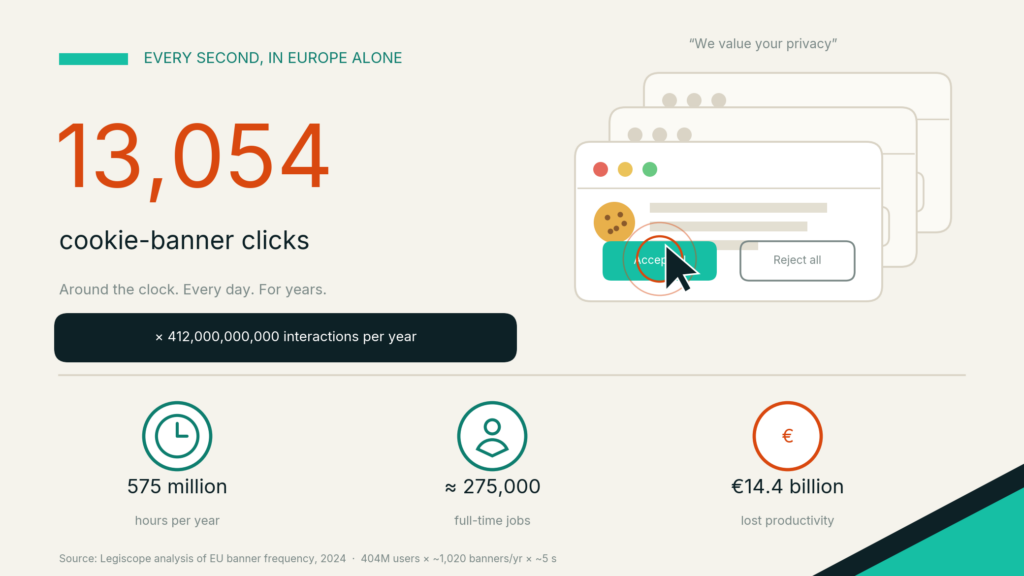
The scale of the clicking, from Legiscope’s 2024 analysis of EU banner frequency.[1] That number is staggering on its own. But it only becomes a scandal when you ask the obvious follow-up question: what did all that clicking buy us?
The answer, supported by peer-reviewed research and now effectively conceded by the European Commission itself, is: almost nothing. The cookie consent regime — born in the EU’s ePrivacy Directive and supercharged by the GDPR’s strict consent standard in 2018 — has imposed enormous, measurable costs on billions of people while delivering privacy protection that is largely theatrical.
First, a quick correction to the popular story
Cookie banners are usually blamed on the GDPR, but the consent requirement actually comes from an older law: the ePrivacy Directive of 2002, amended in 2009 to require opt-in consent before websites store non-essential cookies. What the GDPR did in 2018 was raise the bar for what counts as valid consent — it must be freely given, specific, informed, and unambiguous.[1] That stricter standard is what turned a quiet legal requirement into the wall of pop-ups we know today. So the fair target of criticism is the whole EU consent-banner regime: the ePrivacy rules and the GDPR consent standard working together. That’s the regime this post examines — and the distinction matters, because the EU is now trying to reform exactly this combination.
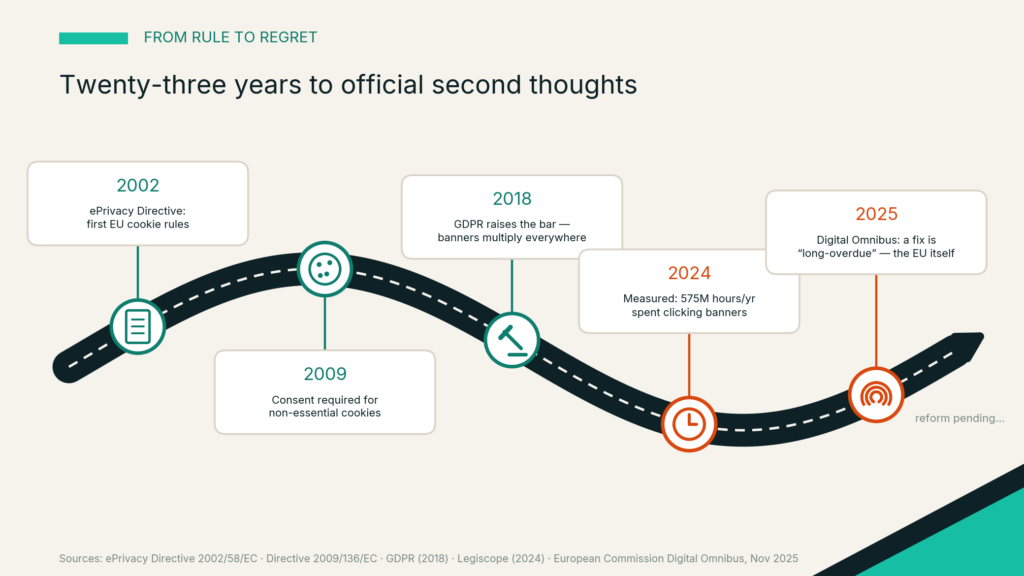
Twenty-three years from the first EU cookie rule to the EU’s own second thoughts. The lock that doesn’t lock
The entire premise of a consent banner is a bargain: you make a choice, and websites respect it. If that bargain fails, every banner on the internet is friction without function. And the research says the bargain fails — comprehensively.
The mechanism is browser fingerprinting. Your browser constantly reveals small technical details — screen resolution, installed fonts, time zone, graphics hardware quirks. Combined, these form a “fingerprint” that is unique for the large majority of devices, allowing a website to recognize and follow you without storing a single cookie. No cookie means the cookie-consent machinery never even gets involved.
This isn’t theoretical. A peer-reviewed study presented at The Web Conference examined how websites behave around their own consent banners, and the results are devastating for the consent model:[3]
- 73.5% of websites that fingerprint do so regardless of what you click. Accept, reject, ignore — the tracking is identical.
- 279 sites in the study fingerprinted visitors before they touched the banner at all.
- And here is the finding that should end the debate: more sites (285) fingerprinted users after they clicked “Reject All” than before they clicked anything. The researchers concluded that fingerprinting functions as a fallback: when the law successfully blocks the cookie, sites switch to the tracking method the banner can’t touch.
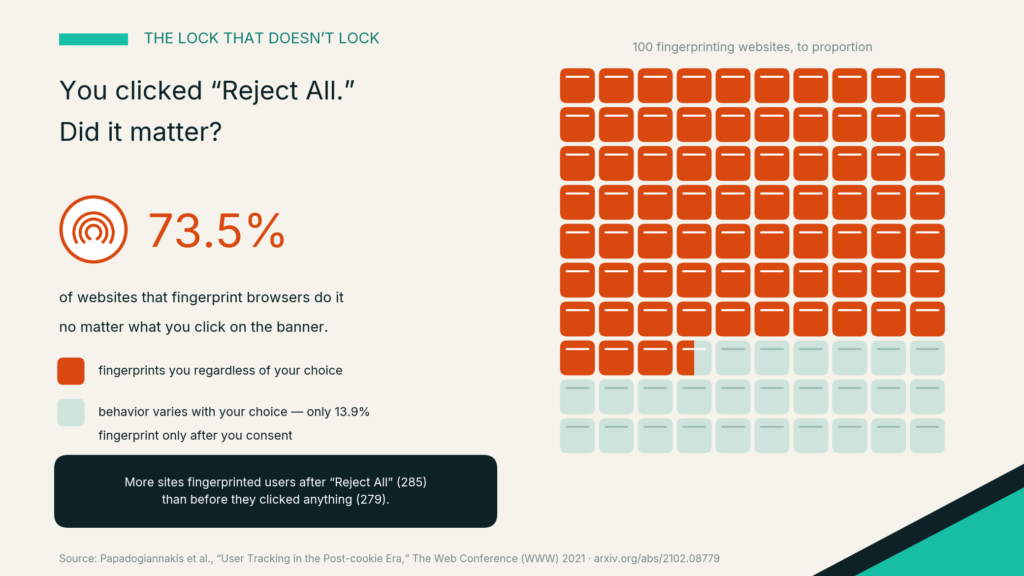
Rejecting tracking can trigger more covert tracking. Data from Papadogiannakis et al., The Web Conference 2021.[3] Read that again: clicking the privacy-protecting button can make you more tracked, not less. The lock on the front door doesn’t lock — and jiggling it tells the burglar you’re worth following through the window.
The follow-up research is just as bleak. A 2025 study by researchers at Johns Hopkins and Texas A&M, presented at the ACM Web Conference, provided the first definitive evidence that fingerprints are used for real cross-site tracking — and found that even users who explicitly opt out under the GDPR and California’s CCPA may still be tracked.[4] An earlier large-scale crawl found that as many as 68.8% of the top 10,000 websites show signs of fingerprinting activity.[5] The consent regime regulates the one tracking technology that politely announces itself, while the silent alternative operates at scale, untouched.
The banners don’t even follow their own law
It gets worse. Even judged purely on its own terms, the regime fails. Multiple studies have found that 80–90% of cookie banners violate the GDPR’s requirements — no working “Reject All” button, dark patterns that make refusing harder than accepting, pre-ticked boxes, and consent extracted under conditions that are anything but free.[1] Faced with this daily obstacle course, users have rationally given up: research finds people click “Accept All” around 90% of the time without reading anything,[6] 76% find the pop-ups irritating, and 68% simply don’t want to deal with them at all.[7]
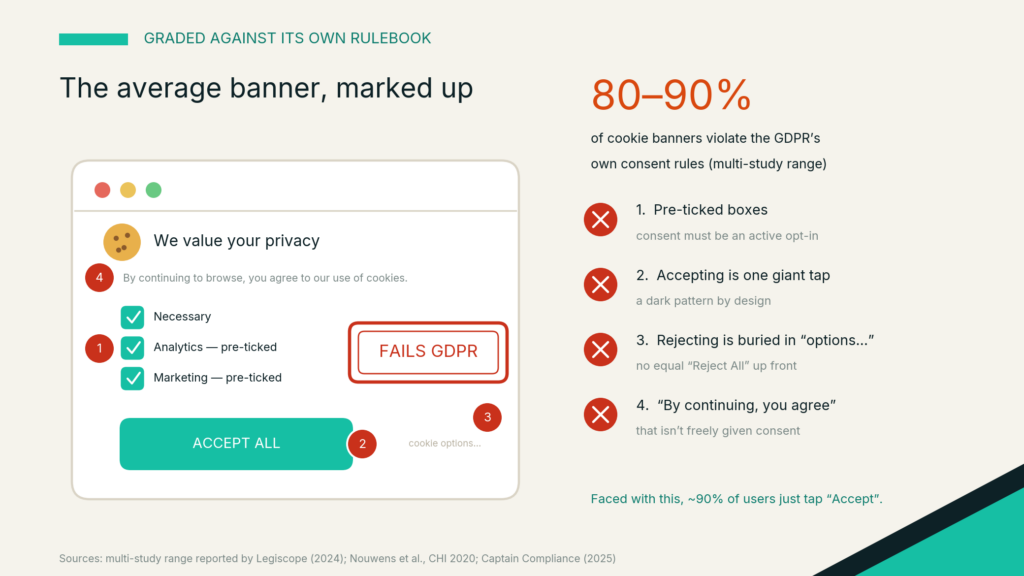
The consent regime, graded against its own rulebook.[1] This is the definition of a failed policy: a rule that nearly everyone violates, that nearly everyone resents, that conditions the public to reflexively click “yes” to surveillance — and that doesn’t stop the surveillance anyway.
The bill, itemized
So the benefit side of the ledger is approximately zero. What’s on the cost side? Three things, in sharply descending order of magnitude.
1. Human time: the headline cost
The numbers from the opening bear repeating, because they are the heart of the case. Legiscope’s analysis works from simple, checkable inputs: roughly 404 million EU internet users, visiting about 100 sites a month, with about 85% of sites showing a banner, at roughly five seconds per interaction. The product is 575 million hours per year — the equivalent of 275,000 full-time jobs spent doing nothing but dismissing pop-ups, valued at about €14.4 billion annually at average European wages.[1],[2]
And that is the EU-only floor. Because websites over-comply globally rather than build separate versions per jurisdiction, banners now confront users far beyond Europe. If the rest of the world’s internet users encounter banners at even a fraction of the EU rate, the global figure plausibly runs to billions of hours every year.
2. Money: an industry built on friction
A banner is the visible tip of a software stack. Behind it sits a “consent management platform” (CMP) — software whose only job is to display banners, record choices, and block or fire trackers accordingly. An entire industry now exists to sell this. Market analysts size the global consent-management market between roughly $1 billion and $3.5 billion per year depending on definitions,[9],[10] and the largest vendor, OneTrust, alone generates an estimated $1.2 billion in annual revenue.[11] For small businesses, compliance costs can exceed €10,000 a year once legal review and implementation are counted.[6] None of this spending makes a product better, a page faster, or a user safer. It is pure regulatory overhead — a multi-billion-euro tax on the act of having a website.
3. Energy and data: real, but honestly small
Every banner is also code: scripts that must be downloaded, executed, and answered on every page load. A French web-performance audit of eleven major CMPs found they transfer up to tens of kilobytes per page load before the user touches anything, and measurably degrade Core Web Vitals — the loading and responsiveness metrics that define how fast the web feels.[12],[14]
What does that cost in energy? Here we’ll show our math rather than hide it, because nobody has published a definitive study:
Back-of-envelope, EU only, per year: 412 billion banner interactions × 30–100 KB of consent-related transfer ≈ 12–41 petabytes of traffic. At commonly used network-energy coefficients (which are genuinely contested, with estimates up to 0.066 kWh/GB at the high end[13]), plus the marginal device power burned during 575 million hours of banner-clicking, the total lands in the range of roughly 10–25 GWh and a few thousand tonnes of CO₂ per year — on the order of taking on the low thousands of cars’ worth of emissions and a few million euros of electricity. Treat these as order-of-magnitude estimates only.
We could have inflated this number. We didn’t, because honesty is the point: the energy cost is real but it is a rounding error next to the human cost. The chart below puts all three on one (logarithmic) scale.
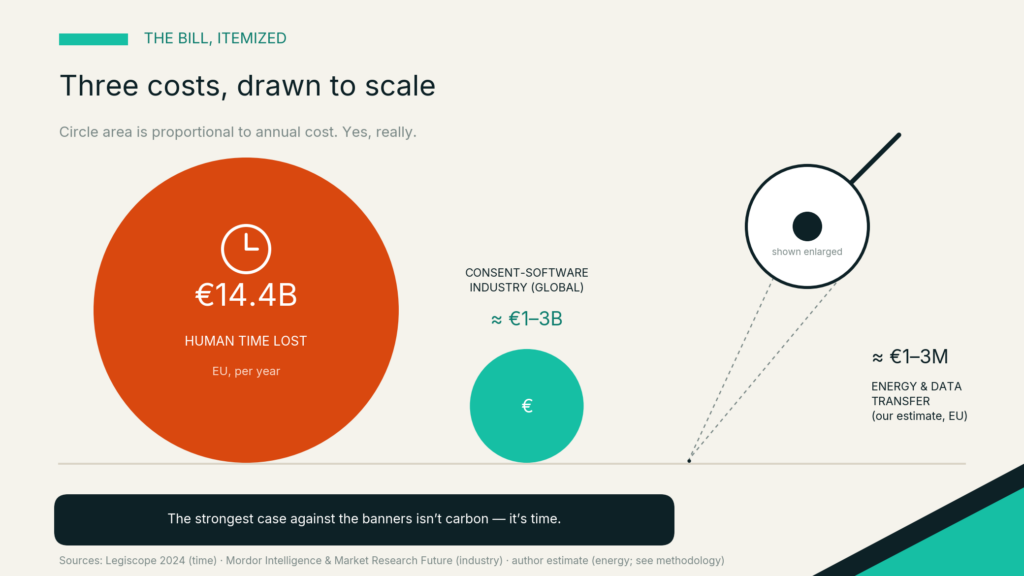
Three cost categories, drawn to scale — circle area is proportional to annual cost. The energy dot needs a magnifier. Even Brussels agrees now
Here is the remarkable part: this is no longer a contrarian argument. In November 2025, the European Commission published its Digital Omnibus proposal — a sweeping package to simplify the GDPR and ePrivacy rules. In its own explanatory memorandum, the Commission acknowledges that consent fatigue and the proliferation of cookie banners have become a problem whose regulatory solution is, in its words,
long-overdue
.[8] As one law firm dryly observed, that is a remarkable self-description for a problem created by EU law itself.[8] The Commission has been blunter still about the clicking ritual, admitting:This is not a real choice made by citizens to protect their phones or computers.
[7]The proposed fix — fewer consent triggers, mandatory one-click rejection, and eventually machine-readable preference signals set once in your browser and honored everywhere — is a tacit admission that two decades of per-site banners failed.[8],[15] Whether the reform survives the legislative process intact, and whether it actually ends banner fatigue, remains genuinely uncertain; legal analysts are skeptical.[8] But the verdict on the existing regime has been delivered by its own author.
What would have worked instead
The tragedy is that the better design was always available. A browser-level signal — set your preference once, have every site legally bound to respect it — eliminates the per-site banner entirely while expressing a more genuine choice than 412 billion reflexive clicks ever could. The United States’ Global Privacy Control works on exactly this principle, and the Digital Omnibus now points the same direction.[15] Pair that with enforcement aimed at covert tracking — fingerprinting — rather than at the one technology that politely asks first, and you get more actual privacy for a tiny fraction of the cost.
To be fair to the other side: privacy advocates argue that the consent regime, however clumsy, at least forced data collection into the open, and they warn that loosening it could legitimize even more tracking — one advocacy group memorably called the focus on cookies
rearranging deckchairs on the Titanic
, the Titanic being surveillance advertising itself.[6] That’s a serious concern, and any reform should be judged on whether it actually constrains fingerprinting and surveillance advertising rather than merely hiding them. But it is not a defense of the banners. On the banners, the evidence is in.The verdict
Judge the EU consent-banner regime as you would any policy: by its costs and its results. The costs are 575 million hours of European life per year, €14.4 billion in lost productivity, a multi-billion-euro compliance industry, and a measurably slower, heavier web. The results are banners that 80–90% of sites implement illegally, that 90% of users click through blindly, and that do nothing to stop the fingerprint-based tracking happening underneath — tracking that can actually intensify when you click “Reject.”
Thirteen thousand clicks per second. For nothing. It is one of the largest small-scale wastes of human attention ever legislated into existence — and the first step to fixing it is saying so plainly.
Methodology note
The headline time figures come from Legiscope’s published methodology (404M EU users × ~1,020 banners/year × ~5 seconds), which we treat as a reasonable central estimate rather than gospel; halving the per-banner time still yields hundreds of millions of hours. The energy estimate is our own and is presented as an order-of-magnitude range; we deliberately rank it as the smallest cost category. Market-size figures for consent software vary widely between analysts and are presented as a range. The fingerprinting findings are from peer-reviewed studies linked below. We have avoided counting GDPR’s broader compliance costs (data audits, DPOs, legal fees), which are real but not attributable to banners specifically.
Sources
- Legiscope, Cookie banners: 575 million hours — the hidden productivity drain (2024). legiscope.com
- AnythingCounter, How many cookie consent banners are clicked every day? — methodology recap of the Legiscope figures (13,054 clicks/second; €14.4B). anythingcounter.com
- E. Papadogiannakis, P. Papadopoulos, N. Kourtellis, E. P. Markatos, User Tracking in the Post-cookie Era: How Websites Bypass GDPR Consent to Track Users, Proceedings of The Web Conference (WWW) 2021. arxiv.org/abs/2102.08779
- Johns Hopkins University, Websites are tracking you via browser fingerprinting — coverage of the FPTrace study presented at the ACM Web Conference 2025. cs.jhu.edu
- N. M. Al-Fannah, W. Li, C. J. Mitchell, Beyond Cookie Monster Amnesia: Real World Persistent Online Tracking (2019). arxiv.org/abs/1905.09581
- Captain Compliance, The EU’s Cookie Consent Saga (2025) — accept-all rates, SME compliance costs, and the EDRi position. captaincompliance.com
- Chamber of Progress, EU’s Cure for Cookie Fatigue (2026) — user-irritation survey figures and the Commission’s “not a real choice” statement. progresschamber.org
- Osborne Clarke, Digital Omnibus reshapes EU cookie rules but leaves banner fatigue largely intact (Dec 2025) — analysis of the Commission’s explanatory memorandum. osborneclarke.com
- Mordor Intelligence, Consent Management Market (~$1.07B in 2026). mordorintelligence.com
- Market Research Future, Consent Management Market (~$3.52B in 2024). marketresearchfuture.com
- Spherical Insights, Top 20 Companies in the Consent Management Market (OneTrust revenue estimate). sphericalinsights.com
- Agence Web Performance, CMP / Cookie Banner and web performance: comparison of 11 tools (2023). agencewebperformance.fr
- Greenly, What is the Carbon Footprint of Data Storage? — energy-per-gigabyte coefficients (note these are contested and likely upper-bound). greenly.earth
- DebugBear, Cookie Consent Banners, Page Speed, and Core Web Vitals (2025). debugbear.com
- iubenda, The European Commission’s proposal for new cookie rules (2026) — overview of browser-level preference signals in the Digital Omnibus. iubenda.com
-
Consumer AI Devices and Compute-Fueled Boom (Links) – Jun. 13, 2026
-
WSJ: Siri AI’s Secret Weapon: It’s Always Right There (Jun. 9, 2026)
Apple unveiled a new Siri, powered by Gemini-based Apple Intelligence, built into iPhones, iPads, and Macs, that offers camera-based answers, on-device personal data access, and privacy safeguards. -
Reuters: No tech rule exemption for Apple, EU regulators say amid spat over Siri AI delay (Jun. 9, 2026)
EU regulators denied Apple’s 18-month exemption under the Digital Markets Act, saying Apple failed to meet interoperability, privacy, and security standards. Apple delayed Siri AI in the EU, but the Commission said that choice was Apple’s alone. -
MacRumors: Apple Reveals New AI Architecture Built Around Google Gemini Models (Jun. 8, 2026)
Apple unveiled a new Apple Intelligence architecture built on foundation models co-developed with Google, using Gemini tech, on-device and via Private Cloud Compute. -
Simon Willison: Siri AI at WWDC 2026 (Jun. 8, 2026)
Apple unveiled next-generation Siri AI and Core AI tools, licensing a Gemini-derived model for Private Cloud Compute, partly on Google Cloud with NVIDIA GPUs. Vision LLMs, Core AI PyTorch extensions, and waitlisted beta access will shape developer and user tests. -
WSJ: OpenAI Files IPO Paperwork With SEC (Jun. 8, 2026)
OpenAI confidentially filed for an IPO with the SEC, preparing for a possible public listing this fall while saying it may delay due to private-company advantages. -
WSJ: Google to Pay SpaceX Nearly $1 Billion a Month in Cloud-Computing Deal (Jun. 5, 2026)
Google will rent SpaceX compute capacity, paying $920 million monthly from October 2026 to June 2029 for at least 110,000 Nvidia chips, with cancellation rights. The deal expands SpaceX’s AI business, and fills Google’s urgent Gemini Enterprise capacity needs. -
WSJ: Anthropic Files IPO Paperwork – WSJ (Jun. 1, 2026)
Anthropic filed confidentially for an IPO, after rapid growth and a $965 billion valuation, potentially going public this fall. Its enterprise focus, large funding, compute limits, and legal fights with the U.S. government could affect the offering. -
TechCrunch: Meta is reportedly developing an AI pendant (May 30, 2026)
Meta is building an AI pendant that records conversations, plans testing next year, and leverages the Limitless acquisition. It also plans AI glasses, a Wearables for Work subscription/ -
Variety: YouTube to Automatically Label AI-Generated Videos & Enhance Labels (May 27, 2026)
YouTube will automatically label videos with significant photorealistic AI use, place labels under the player or as Shorts overlays, and still ask creators to disclose AI. -
WSJ: Wall Street Is Rushing to Fund the AI Bonanza in Every Conceivable Way (Jun. 8, 2026)
Tech companies are raising massive cash—equity, bonds, IPOs—to build AI data centers and buy chips, fueling a global fundraising boom. -
WSJ: Amazon Strikes $6 Billion Deal With Snowflake for Agentic Computing Chips (May 27, 2026)
Amazon Web Services struck a $6 billion, five-year deal with Snowflake for access to Graviton CPUs in AWS data centers, joining buyers Meta, Apple, and others. It reflects surging CPU demand from agentic AI. -
NY Times: Have a Thorny Medical Question? Your Doctor May Be Using A.I. for That. (Jun. 8, 2026)
OpenEvidence, an A.I. app trained on medical journals, is widely used by physicians to answer millions of clinical questions. -
WSJ: To Master Artificial Intelligence, Students Should Totally Avoid It (Jun. 9, 2026)
St. Dunstan’s Academy rejects early screen and AI use, arguing short AI exposure harms attention, creativity, and learning, and that delaying AI teaches mastery rather than dependence. -
NY Times: In the Hybrid A.I.-Human Work Force, Who Will Actually Thrive? (Jun. 9, 2026)
Experts say A.I. will create hybrid A.I.-human roles, but displace many entry-level, routine jobs. They warn about impacts in warehouses, insurance, and trucking. -
NY Times: A.I. Degree Programs Surge as Colleges Seek Students and Relevance (Jun. 8, 2026)
Colleges across the U.S. are rapidly adding A.I. majors and minors, with programs ranging from deep technical theory to applied, ethics-focused courses. -
WSJ: University Endowments Are About to Strike It Big on the SpaceX IPO (Jun. 8, 2026)
Many U.S. university endowments hold sizable SpaceX stakes, sometimes exceeding 10%, via early venture investments, positioning them for large paper gains when the company goes public. -
WSJ: Robinhood Lets Customers Use AI to Trade Stocks, Make Credit-Card Purchases (May 27, 2026)
Robinhood lets customers link AI agents to dedicated investment accounts to trade stocks, and to virtual Gold cards to find deals, monitor availability, and make purchases within limits.
-
WSJ: Siri AI’s Secret Weapon: It’s Always Right There (Jun. 9, 2026)