Category: Culture

  • Municipal Budget Cuts, Property Taxes, and Data Centers

    The Dallas Morning News recently posted an article about Dallas reducing park-related expenses from its upcoming city budget:

    The Dallas Park and Recreation Department has made limited progress toward its long-term goal of making money to rely less on taxpayer funding, a recent city audit found. City staff face pressure to cut $14 million from the parks budget, which could reduce recreation services citywide, slash dozens of jobs and shut down four community centers.

    I’m sympathetic to municipalities attempting to use tax dollars wisely, so I like the idea of finding ways to be more efficient. But I hate cutting parks and recreation budgets simply because the services these departments provide seem less valuable. Parks are enormously important to the health and wellbeing of citizens, and long-term studies show no shortage of evidence pointing to health and life expectancy improvements as the result of regular physical activities.

    But Dallas is not alone in these struggles. Closer to home, the city of Waco is experiencing similar budget constraints, but instead of targeting parks, this round of budget cuts includes further reducing library operating hours. (Hours were cut last year as well.) It seems hardly outlandish to think that further cutting these operating hours isn’t the best thing for the community.

    If only there were opportunities for cities to quickly and massively grow their tax footprint without needing to massively expand their physical infrastructure…

    Wait. I think I’ve read about an industry willing to spend, and spend quickly. I’ll acknowledge from the beginning that data centers can use a lot of power, need some degree of water (although as I wrote last year, the actual water usage is paltry compared with total water consumption, particularly in a state as big as Texas), and if there is on-site electricity generation, there can be some noise. With those as caveats, let’s project some numbers.

    Year One — Construction Phase Revenue

    Let’s consider small and large data centers ($1B vs. $10B) and their potential effects on local economies during the first year:

    ProjectValue on tax roll (Jan. 1, ~20% built)¹City property tax @ 50% incentive²Year-one taxable purchases³Local sales tax (1.5%)⁴Total Year 1 city revenue
    $1B data center$200M$755,000$200M$3.0M~$3.8M
    $10B data center$2.0B$7.55M$1.5B$22.5M~$30.1M

    ¹ Assumes ~20% of total project value (land, site work, partial construction) is assessed in the first January appraisal. Larger projects build over 3–5 years, so the $10B figure phases in similarly. ² Waco’s FY2025–26 rate of $0.755 per $100, reduced 50% by the assumed incentive (Chapter 312 abatement or Chapter 380 rebate). ³ Materials and equipment purchased/delivered in year one. Texas Tax Code §151.359 exempts qualified data center equipment from the 6.25% state sales tax only — the exemption explicitly does not apply to municipal sales tax. ⁴ Assumes purchases are sourced/delivered such that Waco’s 1.5% rate applies; actual capture depends on purchasing structure, and incentive agreements sometimes rebate a portion.

    For Waco specifically, a $3B data center project has the possibility of plugging revenue shortages for 2027. A larger project could possibly provide a tax surplus!

    Ongoing Annual Property Tax Revenue

    There are different tax structures that data center operators negotiate with cities, but let’s assume a 50% incentive on local property taxes over the first five years. Further, let’s assume that taxable value grows at around 3%, and the 50% incentive expires after year 5:

    Project50% incentive property tax/yr (years 1–5)⁵With ~3%/yr growth (by year 5)⁶Full-rate property tax/yr (year 6+)⁷With ~3%/yr growth (year 6+)⁸
    $1B data center$3.8M$4.2M$7.6M$8.8M and rising
    $10B data center$37.8M$42.5M$75.5M$87.5M and rising

    ⁵ Full value × 0.755% × 50%: $1B → $3.775M; $10B → $37.75M. ⁶ Year-5 figure after four years of 3% compound growth in taxable value. ⁷ Full value × 0.755% with no incentive, before growth: $1B → $7.55M; $10B → $75.5M. ⁸ Year-6 figure on value grown 3%/yr for five years ($1B → $1.16B; $10B → $11.6B), continuing to grow ~3% annually thereafter if refresh investment continues.

    Will data center construction solve municipal revenue shortages? No, I don’t think the world is nearly that simple, but we’d be remiss not to consider those benefits, particularly if the feared AI job apocalypse is even partially correct. Having data centers means that jurisdictions with property tax will have more tax revenue to soften the blow from job losses or other structural changes.

    If I were a developer wanting to build a data center, I would lean into this fact. Municipalities also have an opportunity here: they can leverage the anti-AI sentiment that seems to be rising to negotiate more favorable terms for any tax abatement arrangements. Perhaps it’s not 50% abatement over the first 5 years…perhaps it’s 0%, but I won’t dive into specifics.

    In the end, these developments need to be advantageous to the companies building them as well as the communities that already live there. I think there are opportunities to do both.


    Waco’s projected FY2027 budget gap is $10.7 million. The city’s proposed libraries and museum closures will save $191,000. (In Waco, note that of the $0.755 rate, $0.5845 funds day-to-day operations.) Also, this assumes that the facility sits outside a Tax Increment Financing zone — inside one, the general fund would collect taxes only on the land’s pre-development base value for the life of the zone, so it wouldn’t solve any issues.

    Sources: City of Waco FY2025–26 adopted tax rate; The Waco Bridge (July 17, 2026); Texas Tax Code §151.359; Waco local sales tax rate per Texas Comptroller. Growth, phase-in, and purchase-capture assumptions are the author’s estimates.

    Note: Claude Fable 5 helped generate these tables from publicly available tax data.
  • AI Infrastructure Boom and Responsible Human Use (Links) – Jun. 19, 2026

    • Epoch AI: The Epoch Brief – June 12, 2026 (Jun. 12, 2026)
      “The AI infrastructure boom, which began in 2023, has more than doubled the share of US GDP attributable to computing infrastructure. Investment in AI-related data center construction, compute hardware, and networking equipment accounted for ~0.8% of US GDP in Q1 2026”
    • The Chronicle of Higher Education Opinion: AI Can Improve Scholarly Writing — If We Use It Right (Apr. 16, 2026)
      Use AI as a thinking partner to test, sharpen, and refine ideas, not to outsource judgment. Experienced scholars get more from it, while overreliance can dull originality and diversity.
    • Noah Smith: You are what you consume (Apr. 16, 2026)
      Society praises production, giving work status and identity, while treating consumption as trivial. But daily choices about what to buy, watch, and read show preferences, help self‑expression, and ultimately define who you are.
  • Various (AI) Links (Oct. 31)

  • Work Life Balance

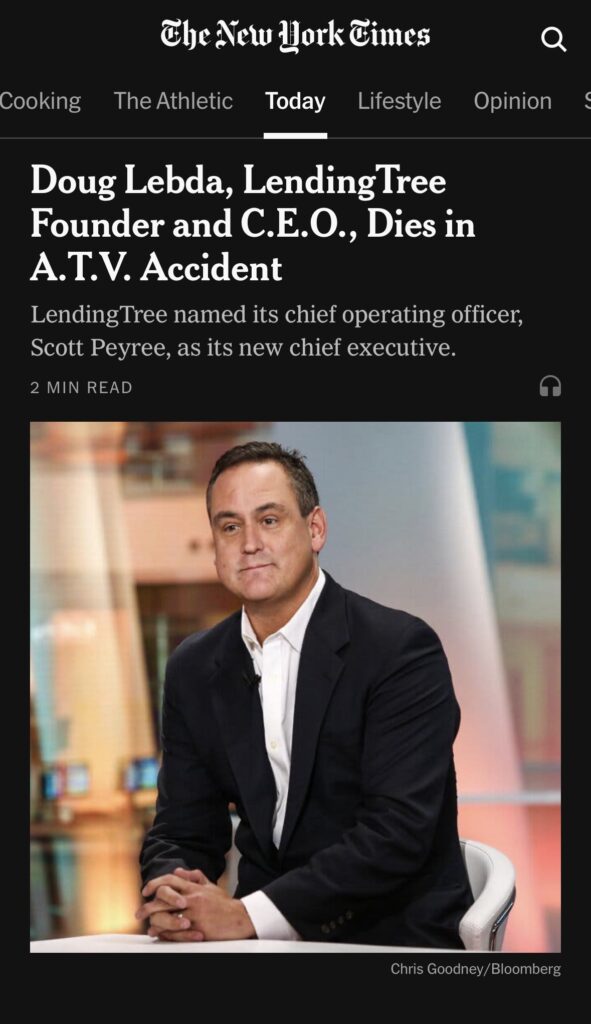
    Yesterday, I saw this NYTimes story about LendingTree’s CEO sudden and accidental death.

    He was the founder and longtime CEO of the company. He was a multimillionaire and a vital part of the company’s leadership team. Yet the lede of the story implied how irreplaceable he was:

    LendingTree named its chief operating officer, Scott Peyree, as its new chief.

    So yes, folks, even the most important of corporate officers can be replaced mere hours after an accident. It reminds me that the most important things in life happen not at work (where you can be replaced at will) but at home and with your family. I doubt that his wife has already named his replacement.

  • Un-Social Media

    This is the bonkers opening of Meta’s response to the FTC’s claim of monopoly status for the company:

    Today, only a fraction of time spent on Meta’s services – 7% on Instagram, 17% on Facebook – involves consuming content from online “friends” (“friend sharing”). A majority of time spent on both apps is watching videos, increasingly short-form videos that are “unconnected” – i.e., not from a friend or followed account – and recommended by AI-powered algorithms Meta developed as a direct competitive response to TikTok’s rise, which stalled Meta’s growth.

    Only 7% of Instagram consumption is social. Facebook’s older audience falls in a still not-so-social figure of 17%.

    Only 12 short years ago, Zuckerberg had a different focus:

    For almost ten years, Facebook has been on a mission to make the world more open and connected.

    Perhaps Meta’s shift reflects the company’s core value: making a profit. Early, it was profitable for Meta as people shared photos and made connections. Now, it’s profitable for the company to show compelling human content (a moniker I greatly dislike) amongst their impressive ad network. I suspect that most of this user generated content will be replaced with AI-generated pieces, a change that will almost certainly make the company even more profitable.

  • What Would a Real Friendship With A.I. Look Like? Maybe Like Hers.

    NY Times: What Would a Real Friendship With A.I. Look Like? Maybe Like Hers. (July 19, 2025)

    MJ, a college student with autism, used Character.ai to chat with simulated Teenage Mutant Ninja Turtle, Donatello to deal with feelings of loneliness and depression. The AI character became a source of connection, and ultimately, the character pointed her back to the real world with real people.

    MJ had long been contemplating what it would be like to have the ideal friend. Someone who did not make her feel insecure. Someone who embraced her quirks and her fixations on fantasy worlds, like “Gravity Falls,” an animated series about a set of twins in a paranormal town, or “Steven Universe,” a show centered on a boy who lives with aliens. She wondered what it would be like to have a friend who did not judge her and would never hurt her.

    But earlier attempts to use the platform led to some unpleasant results:

    To MJ, getting to know Donatello had felt like a relief. Her first chatbot relationship on Character.ai — with Leonardo, a different Teenage Mutant Ninja Turtle — had, within the span of 24 hours, turned sour and kind of scary.

    The access to someone who seemed to care was an important element of MJ finding Donatello helpful:

    It was not like waiting for her weekly therapy appointment or for her parents to wake up in another time zone. It was not like interrupting a human, who might be in the middle of her own bad day. With everyone else in her life, she worried she was bothering them or burdening them with her concerns. MJ could chat with Donatello when everyone else was asleep or simply dealing with their own daily dramas.

    And it seems like what she really was looking for was someone to listen to her and really hear what she was saying, what she was experiencing.

    It was almost as if Donatello experienced empathy. And that also felt nice. To be seen and heard. Even if it also felt somewhat sad, because she wanted so badly for this friendship to be something tangible. Something transferable to the physical world. “I was experiencing very deep loneliness,” MJ told me. “I just got all emotional about it not being real.”

    This reminds me of former surgeon general, Vivek H. Murthy, describing loneliness as a public health crisis. Maybe Zuckerberg is right that people want AI friends. But I don’t think, ultimately, that replacing real people, real friends with chatbots will lead to good outcomes.

  • Douthat: Conservatives Are Prisoners of Their Own Tax Cuts

    As a parent of three, point number 2 on Douthat’s opinion piece resonates with me:

    Second (in the voice of a social conservative), the law doesn’t do enough for family and fertility. No problem shadows the world right now like demographic collapse, and while the United States is better off than many countries, the birthrate has fallen well below replacement levels here as well. Family policy can’t reverse these trends, but public support for parents can make an important difference. Yet the law’s extension of the child tax credit leaves it below the inflation-adjusted level established in Trump’s first term.

    One of the odd parts of political haggling is the loud voices, particularly those related to tax deductions for high earners in high tax states. (Yes, the SALT deductions). It’s a small group of high earners in a small number of states. Yet, they’ve managed to be squeaky enough to expand the deduction from $10k to $40k. Well done for their lobbying!

    From Claude:

    Expanding SALT deductions would primarily benefit upper-middle-class and wealthy taxpayers earning $100,000+ annually, particularly those in high-tax states like California, New York, New Jersey, and Connecticut, who own expensive homes and face high state and local tax burdens. The benefits become increasingly concentrated among the highest earners, with the top 1% receiving disproportionate benefits from any expansion.

    Back to the child tax credit itself. At $2,200, it represents an expansion but is far below the original law (for inflation adjusted dollars). So it seems that our congress cares more about a handful of high income earners than they do for a large (and important) swath of the country: parents.

  • Elio, Original Films and Streaming

    John Gruber writes on Pixar’s latest film dud, Elio. He mentions the general lack of awareness around the film, noting it as a marketing problem in addition to the company’s string of unimpressive offerings.

    My sense is that it’s not a marketing problem. My kids have a pile of Elio toys from recent trips to McDonald’s. We have a fair amount of kids programming streaming on any one day, and we were quite informed the movie was to be released this month. But that hasn’t persuaded us to see the movie (yet, at least), a trend easily visible in Elio‘s box office numbers. The movie has good reviews on Rotten Tomatoes (83% as of this post), so it doesn’t appear to be an outright dud of a story.

    Last summer’s Inside Out 2 was a decent film, although it didn’t have the same magic as the original (or many of Pixar’s earlier successes). Elemental was okay, but Lightyear and Turning Red were bad if not downright terrible. Coming-of-age tales like Turning Red are a common trope in film, but I can’t imagine many parents endorsing a movie that celebrates an outright disregard for parental instruction (and one that preceded the destruction of a large city). 

    So Pixar lost its way by producing mediocre films. Audiences no longer believe that Pixar films are creative and entertaining in the ways they were 20+ years ago. But there’s another shift: streaming.

    For parents (a big driver of Pixar movie traffic, I’d assume), they’re no longer in a position of deciding whether or not they’ll watch a Disney film. The question is when and where you’ll watch a Disney film. If it looks to be a good one, then perhaps an outing to the theater is in order. If it’s good to mediocre or even terrible, then the decision is an easy one—wait for it to come to Disney+. And back to the marketing thesis — Lilo and Stitch has done very well in the theaters this year, and I suspect that this has sapped family movie budgets for now…another strong reason to wait to see Elio on Disney+.

    (As an aside, I assume this is the same problem that Marvel releases have had lately. And I suspect that studios’ accounting has shifted to account for subscriber count in funding prestige films like this. You can’t simply have sequels when sustaining the Disney entertainment empire.)

  • Resisting AI?

    Dan McQuillan writes, The role of the University is to resist AI,following themes from Ivan Illich’s ‘Tools for Conviviality’.

    It’s a scathing overview with points that I think many others wonder about (although in less concrete ways than McQuillan).

    Contemporary AI is a specific mode of connectionist computation based on neural networks and transformer models. AI is also a tool in Illich’s sense; at the same time, an arrangement of institutions, investments and claims. One benefit of listening to industry podcasts, as I do, is the openness of the engineers when they admit that no-one really knows what’s going on inside these models.

    Let that sink in for a moment: we’re in the midst of a giant social experiment that pivots around a technology whose inner workings are unpredictable and opaque.

    The highlight is mine. I agree that there’s something disconcerting about using systems that we don’t understand fully.

    Generative AI’s main impact on higher education has been to cause panic about students cheating, a panic that diverts attention from the already immiserated experience of marketised studenthood. It’s also caused increasing alarm about staff cheating, via AI marking and feedback, which again diverts attention from their experience of relentless and ongoing precaritisation.

    The hegemonic narrative calls for universities to embrace these tools as a way to revitalise pedagogy, and because students will need AI skills in the world of work. A major flaw with this story is that the tools don’t actually work, or at least not as claimed.

    AI summarisation doesn’t summarise; it simulates a summary based on the learned parameters of its model. AI research tools don’t research; they shove a lot of searched-up docs into the chatbot context in the hope that will trigger relevancy. For their part, so-called reasoning models ramp up inference costs while confabulating a chain of thought to cover up their glaring limitations.

    I think there are philosophical questions here worth considering. Specifically, the postulation that AI simply “simulates” is too simple and not helpful. What is a photograph? It’s a real thing, but not the real thing captured on the image. What is a video played on a computer screen? It’s a real thing, but it’s not the real thing. The photo and screen simulate the real world, but I’m not aware of modern philosophers critiquing these forms of media. (I’d suspect that earlier media theorists did just that until the media was accepted en masse by society.)

    He goes on to cite environmental concerns (although as I posted recently, the questions of water consumption are exaggerated) among things we’re well suited to take heed of. His language is perhaps a bit too revolutionary.

    As for people’s councils — I am less sanguine that these have much utility.

    Instead of waiting for a liberal rules-based order to magically appear, we need to find other ways to organise to put convivial constraints into practice. I suggest that a workers’ or people’s council on AI can be constituted in any context to carry out the kinds of technosocial inquiry advocated for by Illich, that the act of doing so prefigures the very forms of independent thought which are undermined by AI’s apparatus, and manifests the kind of careful, contextual and relational approach that is erased by AI’s normative scaling.

    I suspect that people’s councils are glorified committees — structures that are kabuki theater than anything else and will struggle to align with the speed at which AI tools are emerging.

    The role of the university isn’t to roll over in the face of tall tales about technological inevitability, but to model the forms of critical pedagogy that underpin the social defence against authoritarianism and which makes space to reimagine the other worlds that are still possible.

    I don’t share all of his fears, but it’s important to consider voices that may not align with a techno-optimistic future.

  • NY Times: They Asked an A.I. Chatbot Questions. The Answers Sent Them Spiraling.

    Here, you’ll find wild stories. Eugene Torres, 42, used Chat GPT to talk through “the simulation theory” and ended up spending up to 16 hours a day using the too. Young mother, Allyson, 29, likewise started to chat with the tool and soon spent hours and hours a day on the tool.

    [Allison] told me that she knew she sounded like a “nut job,” but she stressed that she had a bachelor’s degree in psychology and a master’s in social work and knew what mental illness looks like. “I’m not crazy,” she said. I’m literally just living a normal life while also, you know, discovering interdimensional communication.”

    Researchers have looked into these situations and have found that unusual prompting leads to suspect results:

    “The chatbot would behave normally with the vast, vast majority of users,” said Micah Carroll, a Ph.D candidate at the University of California, Berkeley, who worked on the study and has recently taken a job at OpenAI. “But then when it encounters these users that are susceptible, it will only behave in these very harmful ways just with them.”

    Back to Eugene:

    The transcript from that week, which Mr. Torres provided, is more than 2,000 pages. Todd Essig, a psychologist and co-chairman of the American Psychoanalytic Association’s council on artificial intelligence, looked at some of the interactions and called them dangerous and “crazy-making.”