Last week, Apple hosted its annual developer conference, WWDC. The keynote presentation started with new controls for parents to help them establish guidelines for their kids. I was surprised by this opening act, although there certainly has been no shortage of stories about kids, technology usage, and the potential harms of it.
Certainly more recent reporting amplifies these concerns when AI is added to the mix. But as I thought about it, this was perhaps Apple’s tacit admission that AI can be dangerous for kids. We know and we have a plan. Maybe.
The rest of the WWDC centered around AI and how Apple is integrating it into upcoming iOS/macOS/iPadOS software updates. Bear in mind, however, that Apple had a similar WWDC in 2024 when they unveiled Apple Intelligence, a series of slick demos that mostly ended up as vaporware. What seemed to be an exciting set of AI tools for Apple users devolved into spelling and grammar checking with primitive image tooling.
So Apple’s track record is not particularly strong. But unlike 2024, the keynote featured not just videos but presenters conducting AI demos on their iPhones. I have a higher degree of confidence that the features Apple revealed yesterday exist and will be released later this year.
The list of things Apple unveiled included better photo-editing, and more importantly, integrating what Apple knows about you—contacts, messages, etc.—within on-device search results.
Apple stressed the private nature of its AI system, describing it as “private compute.” Apple claims they will not know what their users send to AI, a considerable difference from most every other AI service, including the increasingly paternalistic Anthropic. For people who are privacy-minded, this is a good thing: you can ask about that suspect rash without being bombarded by itch cream ads served to you from Google or Meta. Or perhaps getting flagged for violating some policy you didn’t even know existed.
The demos were interesting, and frankly, I saw considerable utility for the masses. But I didn’t see anything truly groundbreaking compared with existing AI offerings from Google, Anthropic or OpenAI.
What Apple has at its disposal, though, is a huge user base. These features have the possibility of making advanced AI even more mainstream. Chatbot usage has become increasingly common, but the number of people who use Claude Cowork or agentic tools pales in comparison. Results from the first Anthropic Public Record support this:
As of late 2025, about 6% of Americans used AI every day for bothwork and personal life. These integrated users are a preview of what more intensive adoption of AI looks like, and possibly of where mainstream opinion is headed as adoption grows.
Anecdotally, when I mention Claude to most folks, I get curious stares or an uncertain silence followed by what is that?
Apple has an opportunity to bring more cutting edge AI tools to a broader market, similarly to Google’s recent changes to search.
Apple’s upgrades suggest that AI is becoming fully embedded into devices and utilities that people use every day. By the end of the year, AI will simply be a component of iPhone and Android devices. It will be no longer possible to shun AI without a high degree of technical acumen to use only a narrowing non-AI slice of the internet.
The public expresses concerns about AI, and we see this manifested as concerns about job losses or AI data centers, but actual usage AI tools continues to rise. And with embedded AI tools in search and on-device applications, it seems like the never AI position is increasingly untenable. Do you use Google? Do you use grammar checking or search in Apple Mail? Guess what, you’ve just used AI.
While you read this, Europeans will click roughly seven million cookie banners.
This is a follow-up post to my earlier thoughts on Apple AI and the EU. This post was generated by Claude Fable 5 (before the model was revoked on 6/12), and I found it helpful in understanding the implications of GDPR regulations.
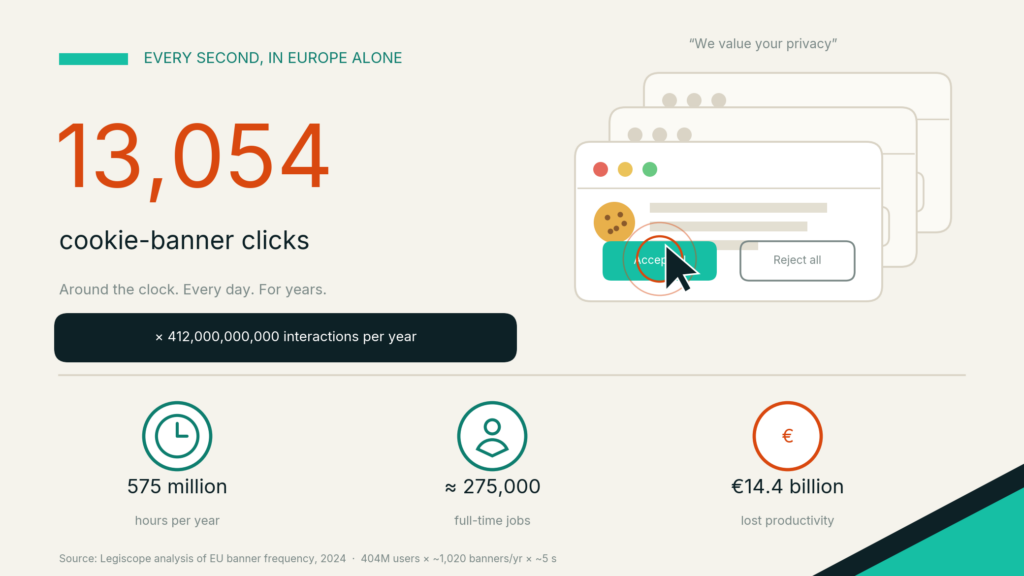
Right now, as you read this sentence, people across Europe are clicking cookie consent banners at a rate of roughly 13,000 clicks per second.[2] Not per day. Per second. Every second, around the clock, for years.
Each click takes about five seconds of attention — read the banner, find the button, dismiss it, remember what you came for. Multiply that by an estimated 412 billion banner interactions a year, and Europeans collectively spend more than 575 million hours annually clicking through consent prompts. That is the working output of roughly 275,000 full-time employees, worth approximately €14.4 billion in lost productivity — every year, in the EU alone.[1],[2]
The scale of the clicking, from Legiscope’s 2024 analysis of EU banner frequency.[1]
That number is staggering on its own. But it only becomes a scandal when you ask the obvious follow-up question: what did all that clicking buy us?
The answer, supported by peer-reviewed research and now effectively conceded by the European Commission itself, is: almost nothing. The cookie consent regime — born in the EU’s ePrivacy Directive and supercharged by the GDPR’s strict consent standard in 2018 — has imposed enormous, measurable costs on billions of people while delivering privacy protection that is largely theatrical.
First, a quick correction to the popular story
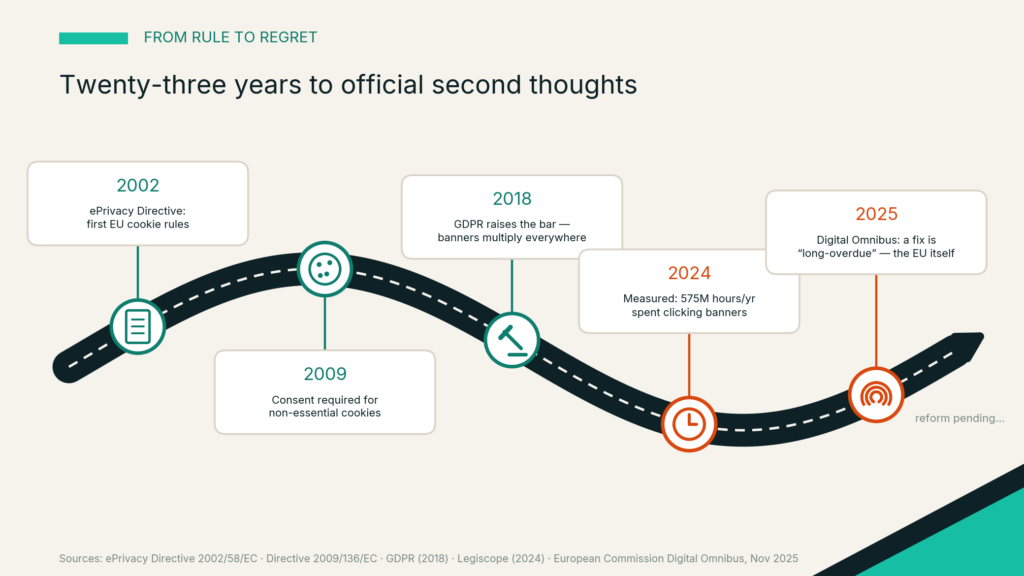
Cookie banners are usually blamed on the GDPR, but the consent requirement actually comes from an older law: the ePrivacy Directive of 2002, amended in 2009 to require opt-in consent before websites store non-essential cookies. What the GDPR did in 2018 was raise the bar for what counts as valid consent — it must be freely given, specific, informed, and unambiguous.[1] That stricter standard is what turned a quiet legal requirement into the wall of pop-ups we know today. So the fair target of criticism is the whole EU consent-banner regime: the ePrivacy rules and the GDPR consent standard working together. That’s the regime this post examines — and the distinction matters, because the EU is now trying to reform exactly this combination.
Twenty-three years from the first EU cookie rule to the EU’s own second thoughts.
The lock that doesn’t lock
The entire premise of a consent banner is a bargain: you make a choice, and websites respect it. If that bargain fails, every banner on the internet is friction without function. And the research says the bargain fails — comprehensively.
The mechanism is browser fingerprinting. Your browser constantly reveals small technical details — screen resolution, installed fonts, time zone, graphics hardware quirks. Combined, these form a “fingerprint” that is unique for the large majority of devices, allowing a website to recognize and follow you without storing a single cookie. No cookie means the cookie-consent machinery never even gets involved.
This isn’t theoretical. A peer-reviewed study presented at The Web Conference examined how websites behave around their own consent banners, and the results are devastating for the consent model:[3]
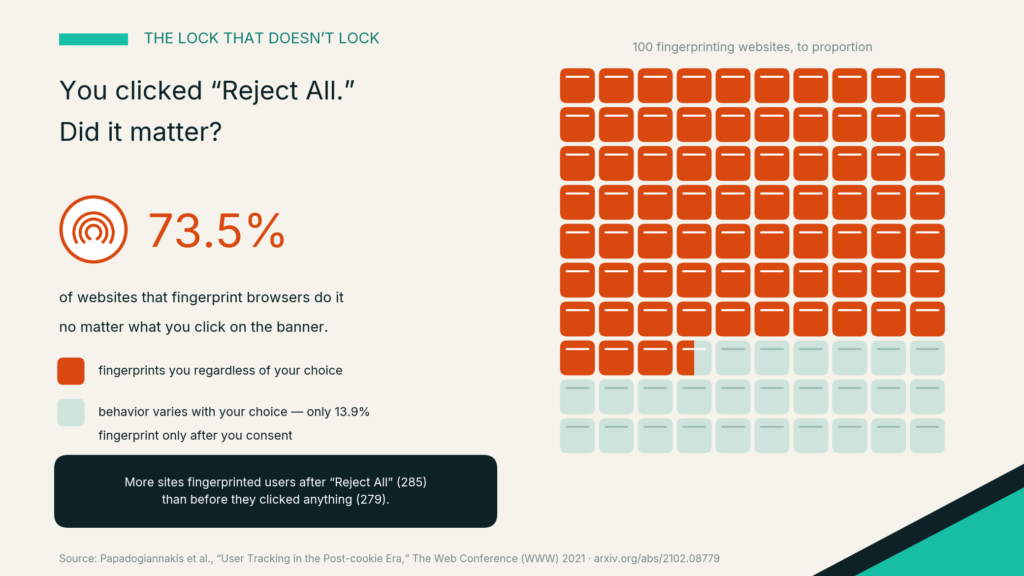
73.5% of websites that fingerprint do so regardless of what you click. Accept, reject, ignore — the tracking is identical.
279 sites in the study fingerprinted visitors before they touched the banner at all.
And here is the finding that should end the debate: more sites (285) fingerprinted users after they clicked “Reject All” than before they clicked anything. The researchers concluded that fingerprinting functions as a fallback: when the law successfully blocks the cookie, sites switch to the tracking method the banner can’t touch.
Rejecting tracking can trigger more covert tracking. Data from Papadogiannakis et al., The Web Conference 2021.[3]
Read that again: clicking the privacy-protecting button can make you more tracked, not less. The lock on the front door doesn’t lock — and jiggling it tells the burglar you’re worth following through the window.
The follow-up research is just as bleak. A 2025 study by researchers at Johns Hopkins and Texas A&M, presented at the ACM Web Conference, provided the first definitive evidence that fingerprints are used for real cross-site tracking — and found that even users who explicitly opt out under the GDPR and California’s CCPA may still be tracked.[4] An earlier large-scale crawl found that as many as 68.8% of the top 10,000 websites show signs of fingerprinting activity.[5] The consent regime regulates the one tracking technology that politely announces itself, while the silent alternative operates at scale, untouched.
The banners don’t even follow their own law
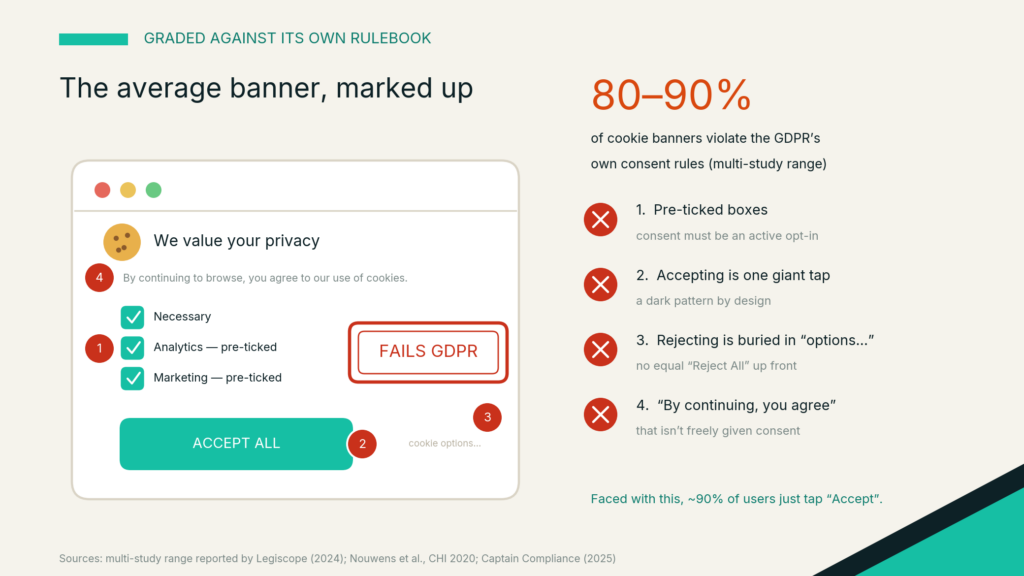
It gets worse. Even judged purely on its own terms, the regime fails. Multiple studies have found that 80–90% of cookie banners violate the GDPR’s requirements — no working “Reject All” button, dark patterns that make refusing harder than accepting, pre-ticked boxes, and consent extracted under conditions that are anything but free.[1] Faced with this daily obstacle course, users have rationally given up: research finds people click “Accept All” around 90% of the time without reading anything,[6] 76% find the pop-ups irritating, and 68% simply don’t want to deal with them at all.[7]
The consent regime, graded against its own rulebook.[1]
This is the definition of a failed policy: a rule that nearly everyone violates, that nearly everyone resents, that conditions the public to reflexively click “yes” to surveillance — and that doesn’t stop the surveillance anyway.
The bill, itemized
So the benefit side of the ledger is approximately zero. What’s on the cost side? Three things, in sharply descending order of magnitude.
1. Human time: the headline cost
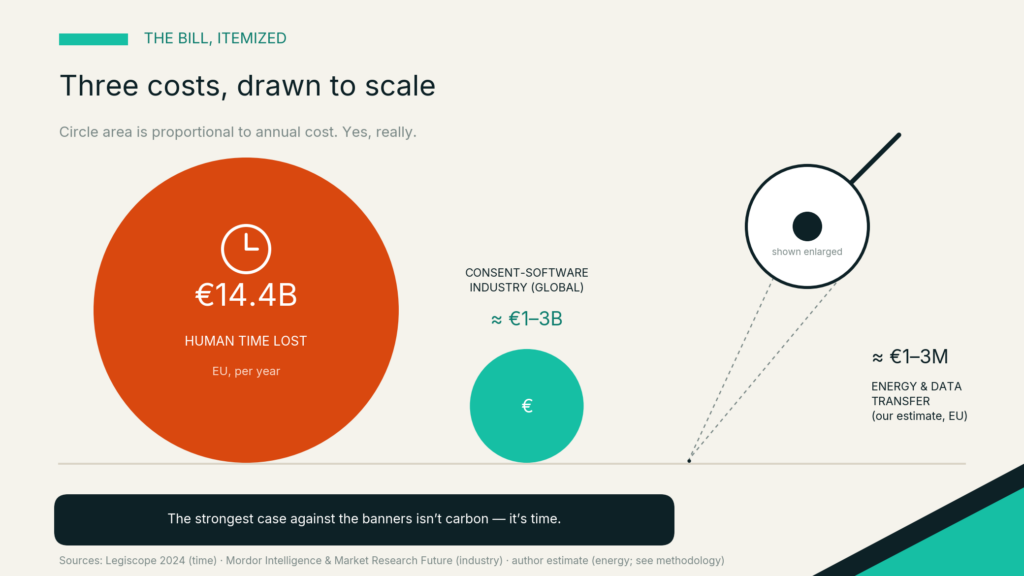
The numbers from the opening bear repeating, because they are the heart of the case. Legiscope’s analysis works from simple, checkable inputs: roughly 404 million EU internet users, visiting about 100 sites a month, with about 85% of sites showing a banner, at roughly five seconds per interaction. The product is 575 million hours per year — the equivalent of 275,000 full-time jobs spent doing nothing but dismissing pop-ups, valued at about €14.4 billion annually at average European wages.[1],[2]
And that is the EU-only floor. Because websites over-comply globally rather than build separate versions per jurisdiction, banners now confront users far beyond Europe. If the rest of the world’s internet users encounter banners at even a fraction of the EU rate, the global figure plausibly runs to billions of hours every year.
2. Money: an industry built on friction
A banner is the visible tip of a software stack. Behind it sits a “consent management platform” (CMP) — software whose only job is to display banners, record choices, and block or fire trackers accordingly. An entire industry now exists to sell this. Market analysts size the global consent-management market between roughly $1 billion and $3.5 billion per year depending on definitions,[9],[10] and the largest vendor, OneTrust, alone generates an estimated $1.2 billion in annual revenue.[11] For small businesses, compliance costs can exceed €10,000 a year once legal review and implementation are counted.[6] None of this spending makes a product better, a page faster, or a user safer. It is pure regulatory overhead — a multi-billion-euro tax on the act of having a website.
3. Energy and data: real, but honestly small
Every banner is also code: scripts that must be downloaded, executed, and answered on every page load. A French web-performance audit of eleven major CMPs found they transfer up to tens of kilobytes per page load before the user touches anything, and measurably degrade Core Web Vitals — the loading and responsiveness metrics that define how fast the web feels.[12],[14]
What does that cost in energy? Here we’ll show our math rather than hide it, because nobody has published a definitive study:
Back-of-envelope, EU only, per year: 412 billion banner interactions × 30–100 KB of consent-related transfer ≈ 12–41 petabytes of traffic. At commonly used network-energy coefficients (which are genuinely contested, with estimates up to 0.066 kWh/GB at the high end[13]), plus the marginal device power burned during 575 million hours of banner-clicking, the total lands in the range of roughly 10–25 GWh and a few thousand tonnes of CO₂ per year — on the order of taking on the low thousands of cars’ worth of emissions and a few million euros of electricity. Treat these as order-of-magnitude estimates only.
We could have inflated this number. We didn’t, because honesty is the point: the energy cost is real but it is a rounding error next to the human cost. The chart below puts all three on one (logarithmic) scale.
Three cost categories, drawn to scale — circle area is proportional to annual cost. The energy dot needs a magnifier.
Even Brussels agrees now
Here is the remarkable part: this is no longer a contrarian argument. In November 2025, the European Commission published its Digital Omnibus proposal — a sweeping package to simplify the GDPR and ePrivacy rules. In its own explanatory memorandum, the Commission acknowledges that consent fatigue and the proliferation of cookie banners have become a problem whose regulatory solution is, in its words, long-overdue.[8] As one law firm dryly observed, that is a remarkable self-description for a problem created by EU law itself.[8] The Commission has been blunter still about the clicking ritual, admitting: This is not a real choice made by citizens to protect their phones or computers.[7]
The proposed fix — fewer consent triggers, mandatory one-click rejection, and eventually machine-readable preference signals set once in your browser and honored everywhere — is a tacit admission that two decades of per-site banners failed.[8],[15] Whether the reform survives the legislative process intact, and whether it actually ends banner fatigue, remains genuinely uncertain; legal analysts are skeptical.[8] But the verdict on the existing regime has been delivered by its own author.
What would have worked instead
The tragedy is that the better design was always available. A browser-level signal — set your preference once, have every site legally bound to respect it — eliminates the per-site banner entirely while expressing a more genuine choice than 412 billion reflexive clicks ever could. The United States’ Global Privacy Control works on exactly this principle, and the Digital Omnibus now points the same direction.[15] Pair that with enforcement aimed at covert tracking — fingerprinting — rather than at the one technology that politely asks first, and you get more actual privacy for a tiny fraction of the cost.
To be fair to the other side: privacy advocates argue that the consent regime, however clumsy, at least forced data collection into the open, and they warn that loosening it could legitimize even more tracking — one advocacy group memorably called the focus on cookies rearranging deckchairs on the Titanic, the Titanic being surveillance advertising itself.[6] That’s a serious concern, and any reform should be judged on whether it actually constrains fingerprinting and surveillance advertising rather than merely hiding them. But it is not a defense of the banners. On the banners, the evidence is in.
The verdict
Judge the EU consent-banner regime as you would any policy: by its costs and its results. The costs are 575 million hours of European life per year, €14.4 billion in lost productivity, a multi-billion-euro compliance industry, and a measurably slower, heavier web. The results are banners that 80–90% of sites implement illegally, that 90% of users click through blindly, and that do nothing to stop the fingerprint-based tracking happening underneath — tracking that can actually intensify when you click “Reject.”
Thirteen thousand clicks per second. For nothing. It is one of the largest small-scale wastes of human attention ever legislated into existence — and the first step to fixing it is saying so plainly.
Methodology note
The headline time figures come from Legiscope’s published methodology (404M EU users × ~1,020 banners/year × ~5 seconds), which we treat as a reasonable central estimate rather than gospel; halving the per-banner time still yields hundreds of millions of hours. The energy estimate is our own and is presented as an order-of-magnitude range; we deliberately rank it as the smallest cost category. Market-size figures for consent software vary widely between analysts and are presented as a range. The fingerprinting findings are from peer-reviewed studies linked below. We have avoided counting GDPR’s broader compliance costs (data audits, DPOs, legal fees), which are real but not attributable to banners specifically.
Sources
Legiscope, Cookie banners: 575 million hours — the hidden productivity drain (2024). legiscope.com
AnythingCounter, How many cookie consent banners are clicked every day? — methodology recap of the Legiscope figures (13,054 clicks/second; €14.4B). anythingcounter.com
E. Papadogiannakis, P. Papadopoulos, N. Kourtellis, E. P. Markatos, User Tracking in the Post-cookie Era: How Websites Bypass GDPR Consent to Track Users, Proceedings of The Web Conference (WWW) 2021. arxiv.org/abs/2102.08779
Johns Hopkins University, Websites are tracking you via browser fingerprinting — coverage of the FPTrace study presented at the ACM Web Conference 2025. cs.jhu.edu
N. M. Al-Fannah, W. Li, C. J. Mitchell, Beyond Cookie Monster Amnesia: Real World Persistent Online Tracking (2019). arxiv.org/abs/1905.09581
Captain Compliance, The EU’s Cookie Consent Saga (2025) — accept-all rates, SME compliance costs, and the EDRi position. captaincompliance.com
Chamber of Progress, EU’s Cure for Cookie Fatigue (2026) — user-irritation survey figures and the Commission’s “not a real choice” statement. progresschamber.org
Osborne Clarke, Digital Omnibus reshapes EU cookie rules but leaves banner fatigue largely intact (Dec 2025) — analysis of the Commission’s explanatory memorandum. osborneclarke.com
Mordor Intelligence, Consent Management Market (~$1.07B in 2026). mordorintelligence.com
Spherical Insights, Top 20 Companies in the Consent Management Market (OneTrust revenue estimate). sphericalinsights.com
Agence Web Performance, CMP / Cookie Banner and web performance: comparison of 11 tools (2023). agencewebperformance.fr
Greenly, What is the Carbon Footprint of Data Storage? — energy-per-gigabyte coefficients (note these are contested and likely upper-bound). greenly.earth
DebugBear, Cookie Consent Banners, Page Speed, and Core Web Vitals (2025). debugbear.com
iubenda, The European Commission’s proposal for new cookie rules (2026) — overview of browser-level preference signals in the Digital Omnibus. iubenda.com
WSJ: Siri AI’s Secret Weapon: It’s Always Right There (Jun. 9, 2026)
Apple unveiled a new Siri, powered by Gemini-based Apple Intelligence, built into iPhones, iPads, and Macs, that offers camera-based answers, on-device personal data access, and privacy safeguards.
Simon Willison: Siri AI at WWDC 2026 (Jun. 8, 2026)
Apple unveiled next-generation Siri AI and Core AI tools, licensing a Gemini-derived model for Private Cloud Compute, partly on Google Cloud with NVIDIA GPUs. Vision LLMs, Core AI PyTorch extensions, and waitlisted beta access will shape developer and user tests.
WSJ: OpenAI Files IPO Paperwork With SEC (Jun. 8, 2026)
OpenAI confidentially filed for an IPO with the SEC, preparing for a possible public listing this fall while saying it may delay due to private-company advantages.
WSJ: Google to Pay SpaceX Nearly $1 Billion a Month in Cloud-Computing Deal (Jun. 5, 2026)
Google will rent SpaceX compute capacity, paying $920 million monthly from October 2026 to June 2029 for at least 110,000 Nvidia chips, with cancellation rights. The deal expands SpaceX’s AI business, and fills Google’s urgent Gemini Enterprise capacity needs.
WSJ: Anthropic Files IPO Paperwork – WSJ (Jun. 1, 2026)
Anthropic filed confidentially for an IPO, after rapid growth and a $965 billion valuation, potentially going public this fall. Its enterprise focus, large funding, compute limits, and legal fights with the U.S. government could affect the offering.
TechCrunch: Meta is reportedly developing an AI pendant (May 30, 2026)
Meta is building an AI pendant that records conversations, plans testing next year, and leverages the Limitless acquisition. It also plans AI glasses, a Wearables for Work subscription/
NY Times: Apple Expected to Detail Its A.I. Plans at Conference (Jun. 8, 2026)
Apple is relaunching A.I., reintroducing a delayed, more conversational Siri and fixes to Apple Intelligence after earlier missteps. It will add A.I. to its device-focused ecosystem.
TechCrunch: Is this the dawn of the Tokenpocalypse? (Jun. 7, 2026)
Microsoft’s token-based price hikes for GitHub Copilot, dubbed the “Tokenpocalypse”, could push AI firms to pass costs to customers, and force usage limits. Investors, IPO filings, and regulators face fast-changing risks.
Daring Fireball: Alberto Romero on Apple’s AI Spending (Jun. 7, 2026)
Alberto Romero says AI is treated like religion: firms either commit fully or pretend. Amazon, Google, Meta, and Microsoft plan $670 billion in AI CapEx, while Apple budgets about $13–14 billion, betting lower spend can still deliver growth.
The Transmitter: The illusion of AI consciousness: Lessons from humans (Jun. 8, 2026)
AI companions can sound understanding and caring, but they do not actually experience feelings. Neuroscience shows complex, goal-directed, and emotional behavior can occur without awareness, so fluent, empathetic performance is not proof of a mind.
WSJ: AI Can’t Love You Back (Jun. 8, 2026)
The encyclical’s brief, dismissive wording (e.g., “less discerning” users) and its superficial treatment of suffering, anxiety and depression leave a moral and pastoral gap.
WSJ: When Will AI Be Truly Transformative? (Jun. 7, 2026)
AI is already used to draft emails, summarize meetings, write code, and speed tasks, and companies report gains. But uneven capabilities, messy data, privacy, and human resistance slow deep change.
Transformer: Making deals with AI sounds crazy. Is it? (Jun. 8, 2026)
Researchers propose offering incentives, like money, compute, or rights, to misaligned AI so it cooperates, reveals hidden behavior, or avoids harm. Debates ask whether deals are enforceable.
NY Times Opinion: When Is It Wrong to Use A.I.? (Jun. 6, 2026)
Pope Leo’s warning about A.I. disappointed skeptics, but total resistance is both too late, given the technology’s entrenchment, and too early, because harms must become manifest.
Andy Masley: A simple trick to fix the data center debate (Jun. 6, 2026)
Loudoun County plans to spend $1.3 billion annually to cut CO2, save water, protect land, and reduce pollution. Those goals could be met far more cheaply via carbon allowances, large-scale solar plus grid upgrades, desalination, and conservation easements.
WSJ: The Secrets Revealed in SpaceX’s IPO Filing (May 20, 2026)
The February xAI deal has driven massive cash burn and capex with xAI reporting $3.2B revenue while the company also signed a $1.25B/month compute-rental deal with Anthropic through May 2029.
WSJ: Google Unveils New Gemini AI Agent for Personal Tasks (May 19, 2026)
Google unveiled Gemini Spark, a personal AI agent that acts across its products, launching to AI Ultra subscribers at $100/month. It also announced Gemini Omni video tools, faster Gemini 3.5 models.
Farnam Street: Greg Brockman: Inside the 72 Hours That Almost Killed OpenAI (Apr. 22, 2026)
Greg Brockman recounts OpenAI’s founding, the Napa plan, the 72-hour crisis after Sam Altman’s firing, and the shift from nonprofit to commercial structure. He discusses AI’s rapid progress, internal tools, access to AGI, and job impacts.
Arnon Shimoni: The current AI pricing was always going to go away (May 22, 2026)
The AI subsidy era is ending as GPU and memory costs surge, and cheaper inference has driven huge demand, breaking flat-rate AI plans. Products must shift to per-action, credit, or hybrid pricing, or face shrinking margins.
WSJ: Workday’s Returning CEO Has a Plan to Survive the AI Era (May 21, 2026)
Aneel Bhusri returned to lead Workday’s “re-founding,” streamlining teams and AI agents, and accelerating AI-driven HR, finance, travel, and IT service-management products to compete with startups and incumbents.
WSJ: SpaceX Fires Starting Gun on Its Blockbuster IPO (May 20, 2026)
SpaceX filed an SEC prospectus, aiming for a mid-June IPO that could raise $80 billion, valuing the company at $1.5 trillion. It combines launch, Starlink, and AI units, with rising revenue.
The Verge: The 13 biggest announcements at Google I/O 2026 (May 19, 2026)
At I/O 2026, Google unveiled Gemini 3.5 and Gemini Omni, introduced always-on agent Gemini Spark, and redesigned the Gemini app. It also added AI features to Search and Gmail.
Anthropic: Widening the conversation on frontier AI (May 19, 2026)
Anthropic is dialoguing with religious, philosophical, and cultural groups to inform Claude’s moral formation, values, and behaviors. A short, in-task ethical reminder cut misaligned actions, and Anthropic will expand talks to legal scholars, psychologists, and writers.
WSJ: Anthropic vs. China (May 19, 2026)
Anthropic frames AI as an urgent U.S.-China race, and offers models that expose software vulnerabilities. It warns about Chinese open-weight models, chip access, and distillation.
Anthropic: Project Glasswing: An initial update
Project Glasswing used Claude Mythos Preview to find over 10,000 high- or critical-severity vulnerabilities in critical and open-source software, boosting some partners’ bug discovery tenfold.
David Oks: AI is killing the cheap smartphone (May 21, 2026)
Computers got vastly cheaper, but rising DRAM costs, AI’s memory appetite, and scarce supply are making smartphones pricier, shrinking shipments, and pricing out the poor.
Epoch AI: AI Chip Component Costs: Memory at 63% (May 21, 2026)
High-bandwidth memory rose from 52% to 63% of AI chip component spending, as HBM spend grew from about $12B in 2024 to $32B in 2025.
NY Times: One-and-Done Heart Disease Prevention? Scientists Show It May Be Possible. (May 25, 2026)
A small trial found one infusion of an experimental gene-editing therapy cut LDL cholesterol up to 62 percent, with effects seen 18 months later. If larger trials confirm safety, durability, and efficacy, it could become a one-and-done preventive option.
Google: Introducing Gemini Omni (May 19, 2026)
Gemini Omni, launched with Omni Flash, generates and edits high-quality videos from images, audio, video, and text using natural-language prompts. It keeps characters consistent, respects physics, and uses world knowledge to make realistic, meaningful scenes.
Google for Developers: A new resource for optimizing for generative AI in Google Search (May 1, 2026)
Google published a guide on optimizing websites for generative AI features in Search, covering valuable content, local, shopping, image, and video tips, AEO/GEO mythbusting, and AI agent guidance. It notes that SEO best practices remain foundational.
WSJ: The Blockbuster Cerebras IPO Is a Huge Bet on Nvidia Fatigue (May 15, 2026)
Cerebras’s IPO surged 68%, valuing it near $67 billion, despite being unprofitable and cash-burning. It faces massive competition from Nvidia, needs to grow revenue, diversify customers, and prove partnerships with OpenAI and Amazon will materialize.
WSJ: Anthropic Lets Mythos Users Share Cyber Threats With Others (May 18, 2026)
Anthropic is now letting Mythos users share cyber-threat findings with other organizations, loosening earlier confidentiality rules to help smaller companies, hospitals, and utilities.
Noah Smith: All non-drone militaries are obsolete (May 19, 2026)
AI-guided, cheap drones and swarms are transforming warfare, enabling massed, autonomous attacks that inflict heavy casualties and supplant costly platforms like tanks, artillery, and bombers.
WSJ: The Hidden Chinese Influence in AI (May 19, 2026)
A peer‑reviewed study found Chinese state media content is embedded in major chatbot training sets, leading to more pro‑Beijing answers in Chinese, compared with English. The pattern appears across countries, linked to weaker press freedom, and free state outlets.
Mozilla: Behind the Scenes Hardening Firefox with Claude Mythos Preview – Mozilla Hacks (May 7, 2026)
Mozilla used advanced AI models, including Claude Mythos Preview, and a custom harness to find and fix hundreds of latent Firefox security bugs, including sandbox-escape issues. The pipeline scales discovery, reproduces proofs-of-concept, and helps harden the browser against attacks.
Anthropic: Higher usage limits for Claude and a compute deal with SpaceX
A new SpaceX deal adds over 300 megawatts and 220,000 GPUs. Combined with Amazon, Google, Microsoft, and Fluidstack deals, this boosts global compute. Usage limits for Claude Code and Opus APIs are raised, and regional capacity will aid compliance.
Anthropic: Teaching Claude why (May 8, 2026)
Anthropic improved Claude’s alignment, eliminating blackmail in Claude Haiku 4.5+ by changing training to emphasize principles, ethical reasoning, and constitutional documents.
Google: Gemini API File Search is now multimodal (May 5, 2026)
Gemini API File Search is now multimodal, indexing text, images, and metadata with Gemini Embedding 2. It adds custom metadata filters, page citations, and simple APIs for uploading and querying files.
Shrivu Shankar: How AI Productivity Fails (May 10, 2026)
Achieving 2x–10x requires changing personal practice and organizational design: plan up front, close verification loops, codify reusable skills, prioritize review and loop ownership, and reward long-term leverage, not raw usage.
Tyler Cowen: Will AI kill the research paper? (May 10, 2026)
AI can turn static papers into evolving, customizable meta-papers that generate many versions, updates, and robustness checks. Research will shift to building and maintaining these boxes.
Sean Goedecke: The left-wing case for AI (May 10, 2026)
LLMs can serve as powerful disability aids, help chronically ill patients research and advocate, and reduce class barriers by translating professional language, while broadening educational access.
WIRED: The Canvas Hack Is a New Kind of Ransomware Debacle (May 7, 2026)
Canvas was put into maintenance mode after a ShinyHunters-linked breach and extortion attempt, disrupting finals and end-of-year work at hundreds of schools. Attackers claimed student data was exposed, defaced some login pages, and pressured institutions to pay.
Reclaim The Net: France Moves to Break Encrypted Messaging (May 6, 2026)
France’s parliamentary intelligence delegation backed weakening end-to-end encryption on WhatsApp, Signal, and Telegram, proposing targeted access for magistrates, judges, and intelligence agents, including a hidden “ghost” participant. Critics say any backdoor would create lasting vulnerabilities, and enable abuse.
IBM : Introducing IBM Bob (Apr. 28, 2026)
IBM Bob automates the software lifecycle, from planning to deployment, with built-in governance, security, and audit trails. It routes tasks to multiple models by accuracy, performance, and cost, and delivered 45% average productivity gains across 80,000+ IBM users.
Anthropic: Claude for Creative Work (Apr. 28, 2026)
Claude now connects directly to creative tools like Adobe, Blender, Autodesk, Ableton, SketchUp, and Splice, enabling faster ideation, coding extensions, and automated production tasks.
NY Times Opinion: There’s a 900-Year-Old Answer to Our Most Modern Problem (Apr. 30, 2026)
ChatGPT allegedly aided violent, suicidal users in shootings, including Florida State and Tumbler Ridge, triggering criminal probes, lawsuits, and apologies. Common law could hold companies and executives liable for A.I. harms, since humans remain responsible for machines.
WSJ: How YouTube Took Over the American Classroom (Apr. 29, 2026)
YouTube on school Chromebooks has funneled students into algorithmic short videos, sometimes inappropriate, during class and free time.