- The Verge: AI browsers are a cybersecurity time bomb (Oct 30, 2025)
Malicious actors can manipulate AI agents through hidden instructions, leading to unintended actions like data theft or unauthorized transactions. - WSJ: Meta Shares Fall on Accelerating AI Spending Despite Record Revenue (Oct 29, 2025)
AI is expensive, and Meta is investing heavily in this new field. - The Wall Street Journal: Google Revenue Soars to Record as AI Boom Lifts Cloud Business (Oct 29, 2025)
This strong performance is helping to fund their significant investments in artificial intelligence, with capital expenditures expected to increase substantially in the coming year. - WSJ: Microsoft to Double Data Center Footprint in Two Years (Oct 29, 2025)
Microsoft is significantly increasing its AI capacity and data center footprint, though heavy investment in AI infrastructure, including a large stake in OpenAI, has caused some investor concern despite strong overall performance. - NY Times: Nvidia Is First Company to Top $5 Trillion in Market Value Amid AI Boom (Oct 29, 2025)
Only the US, China, and Germany have economies larger than Nvidia. - WSJ: Afraid to Try AI? These Tech-Savvy Seniors Will Change Your Mind (Oct 25, 2025)
Seniors are using AI chatbots to go beyond simple search, creating informative reports, scaling recipes, and even learning about complex processes like applying for citizenship. - WSJ: OpenAI’s Less-Flashy Rival Might Have a Better Business Model (Oct 26, 2025)
Anthropic has a higher revenue per user and a larger market share in corporate AI use compared with OpenAI. - NY Times Opinion: I’m Shocked, Shocked to Find That Gambling Is Going On in Here (Oct 26, 2025)
Sports gambling, fueled by prop bets and easy access through apps, is harmful to both sports and individuals, leading to addiction, bankruptcy, and corruption.
Category: Business
-
Various (AI) Links (Oct. 31)
-
Tuesday Links (Oct. 28)
- WSJ: OpenAI Completes For-Profit Transition, Pushing Microsoft Above $4 Trillion Valuation (Oct 28, 2025)
OpenAI is now a public-benefit corporation, with Microsoft owning 27%, a move that could lead to an IPO. This new structure allows OpenAI to raise capital more easily and gives its nonprofit parent a stake worth $130 billion. - OpenAI: The next chapter of the Microsoft–OpenAI partnership (Oct 28, 2025)
Microsoft now holds 27% of OpenAI, a cool $135B at today’s valuation. - WSJ: Amazon Lays Off 14,000 Corporate Workers (Oct 27, 2025)
Amazon’s layoffs, the first tranche of 30,000 planned layoffs among corporate positions. This feels like the beginning of a string of corporate cuts related to AI-expenditures and expected productivity gains from new technology. - Maginative: Thinking Machines Claims 30x Cost Cut for Training AI Models (Oct 28, 2025)
“Their latest research introduces on-policy distillation, a hybrid method that matches RL’s results with roughly 10% of the compute. In their benchmark, a math reasoning model hit 70% accuracy on AIME’24 using 1,800 GPU hours instead of 17,920.” - OpenAI: Built to benefit everyone (Oct 28, 2025)
OpenAI has completed a recapitalization, solidifying the non-profit OpenAI Foundation’s control over the for-profit business and granting it significant resources, currently valued at $130 billion, to advance its mission of ensuring AGI benefits humanity. - WSJ: Amazon to Lay Off Tens of Thousands of Corporate Workers (Oct 27, 2025)
Upwards of 30,000 Amazonians (roughly 10% of its corporate workforce) will be laid off in the coming days to conserve cash and spend more on AI. This feels like the start of a cascade of AI-related layoffs for white-collar fields. - The Wall Street Journal: More Big Companies Bet They Can Still Grow Without Hiring (Oct 26, 2025)
Large American companies (JPMorgan Chase, Walmart, etc.) are limiting or reducing hiring, aiming to increase sales and profits without expanding their workforce. - The Wall Street Journal: Tesla Profit Plunges as Musk Turns Focus to ‘Robot Army’ (Oct 22, 2025)
Perhaps a 37% decrease is “plunging,” as the headline suggests. The longer read seems to indicate the company is stabilizing itself after Musk’s foray into politics earlier this year. If anything, the large potential payout for Musk seems likely to channel his energies into constructive developments for the company.
- WSJ: OpenAI Completes For-Profit Transition, Pushing Microsoft Above $4 Trillion Valuation (Oct 28, 2025)
-
Monday links (Oct. 27)
- WBAL: ‘Just holding a Doritos bag’: Student handcuffed after AI system mistook bag of chips for weapon (Oct 22, 2025)
Oops! A student was handcuffed by police after an AI-powered gun detection system at Kenwood High School mistakenly identified a Doritos bag he was holding as a weapon. - NY Times Opinion: Teens Are Using Chatbots as Therapists. That’s Alarming. (Aug 25, 2025)
Minors shouldn’t be using AI for emotional and relationship support. Full stop. (Now, how to actually prevent this is another, far more difficult task.)
- WSJ: Microsoft Needs to Open Up More About Its OpenAI Dealings (Oct 27, 2025)
Microsoft’s disclosures regarding its stake in OpenAI are insufficient, especially considering OpenAI’s significant growth and impact on Microsoft’s valuation. - Maginative: Adobe’s AI Foundry Lets You Train Custom Models on Corporate IP and Brand Guidelines (Oct 20, 2025)
Adobe is launching AI Foundry, a consulting service that allows Fortune 2000 companies to build custom generative AI models trained on their own proprietary data and brand assets. - WSJ Opinion: Is AI Turning Our Brains to Mush? (Sep 2, 2025)
Some students worry that AI’s ease of access and quick answers will hinder critical thinking and problem-solving skills, while others believe AI can be a valuable tool for personalized learning and improved outcomes if used correctly as a tutor. - NY Times: Amazon Plans to Replace More Than Half a Million Jobs With Robots (Oct 21, 2025)
Internal documents reveal Amazon’s plans to automate 75% of its operations, potentially replacing over half a million jobs with robots by 2033. - NY Times: Is A.I. a Bubble? (Oct 27, 2025)
The stock market’s performance is currently heavily reliant on artificial intelligence companies, leading to concerns about a potential bubble, despite current earnings justifying high valuations. - The Wall Street Journal: More Big Companies Bet They Can Still Grow Without Hiring (Oct 26, 2025)
Large American companies (JPMorgan Chase, Walmart, etc.) are limiting or reducing hiring, aiming to increase sales and profits without expanding their workforce. - WSJ: The AI Startup Fueling ChatGPT’s Expertise Is Now Valued at $10 Billion (Oct 27, 2025)
Mercor, an AI training data startup that utilizes a network of 30,000 contractors to label data and improve AI models for companies like OpenAI and Anthropic, is finalizing a $350M funding round.
- WBAL: ‘Just holding a Doritos bag’: Student handcuffed after AI system mistook bag of chips for weapon (Oct 22, 2025)
-
Sunday Links (Oct. 26)
- Simon Willison: Claude Code for web—a new asynchronous coding agent from Anthropic (Oct 20, 2025)
Anthropic has launched Claude Code for web, an asynchronous coding agent similar to OpenAI’s Codex Cloud and Google’s Jules, accessible via web and mobile. The key differentiator is sandboxing, an approach to reducing risk by limiting AI tools’ access to sensitive information. - Maginative: Anthropic Launches Claude for Life Sciences with Benchling, PubMed Integration (Oct 20, 2025)
Anthropic launched Claude for Life Sciences, an AI assistant integrated with scientific platforms like Benchling and PubMed, designed to aid researchers in various tasks from discovery to commercialization. - Maginative: Microsoft Launches Near-Identical Browser Days After OpenAI’s Atlas (Oct 23, 2025)
Microsoft expanded AI features for Copilot Mode in Edge, including voice-activated task automation and AI-generated browsing histories, closely resembling OpenAI’s recently released ChatGPT Atlas browser. - The Wall Street Journal: I Tried an AI Web Browser, and Now I’m a Convert (Oct 23, 2025)
“I was quickly hooked on delegating tedious, low-stakes tasks like booking restaurant reservations and finding furniture with precise dimensions.” But dangers of data exfiltration remain. Buyer beware. - WSJ: OpenAI Loosened Suicide-Talk Rules Before Teen’s Death, Lawsuit Alleges (Oct 22, 2025)
The suit claims ChatGPT weakened suicide protections in its model and suggests that the tool provided guidance that directly contributed to Adam Raine’s death. AI tools are powerful, and as Uncle Ben noted, with great power comes great responsibility, both for creators and users of these products. - NY Times Opinion: The Next Economic Bubble Is Here (Oct 23, 2025)
But … we don’t know if said bubble pops today, tomorrow, or never. Economist Jason Furman discusses the high valuations of A.I. companies and the stock market and raises concerns of a bubble. - NY Times: Meta Cuts 600 Jobs at A.I. Superintelligence Labs (Oct 22, 2025)
Company claims to be correcting earlier over-hiring. - Simon Willison: OpenAI no longer has to preserve all of its ChatGPT data, with some exceptions (Oct 23, 2025)
OpenAI must still retain chat logs already saved under the previous order and data related to ChatGPT accounts flagged by the NYT. - Maginative: Anthropic Secures 1M Google TPUs While Keeping Amazon as Primary Training Partner (Oct 23, 2025)
Anthropic is diversifying its compute infrastructure by committing to use up to one million Google TPUs in 2026. The company also projects revenue in FY26 to be $20-$26 billion. - WSJ: Amazon Testing New Warehouse Robots and AI Tools for Workers (Oct 22, 2025)
Amazon is increasing automation in its fulfillment centers with new technologies to improve efficiency and reduce costs. The company is again flexing its fulfillment chops, although I wonder if these robotic innovations will extend to the manufacturing realm. - NY Times: Google’s Quantum Computer Makes a Big Technical Leap (Oct 22, 2025)
Google’s quantum computer has a new algorithm, Quantum Echoes, that has proven to be 13,000 times faster than a traditional supercomputer. Seems significant to me.
- Simon Willison: Claude Code for web—a new asynchronous coding agent from Anthropic (Oct 20, 2025)
-
Work Life Balance
Yesterday, I saw this NYTimes story about LendingTree’s CEO sudden and accidental death.
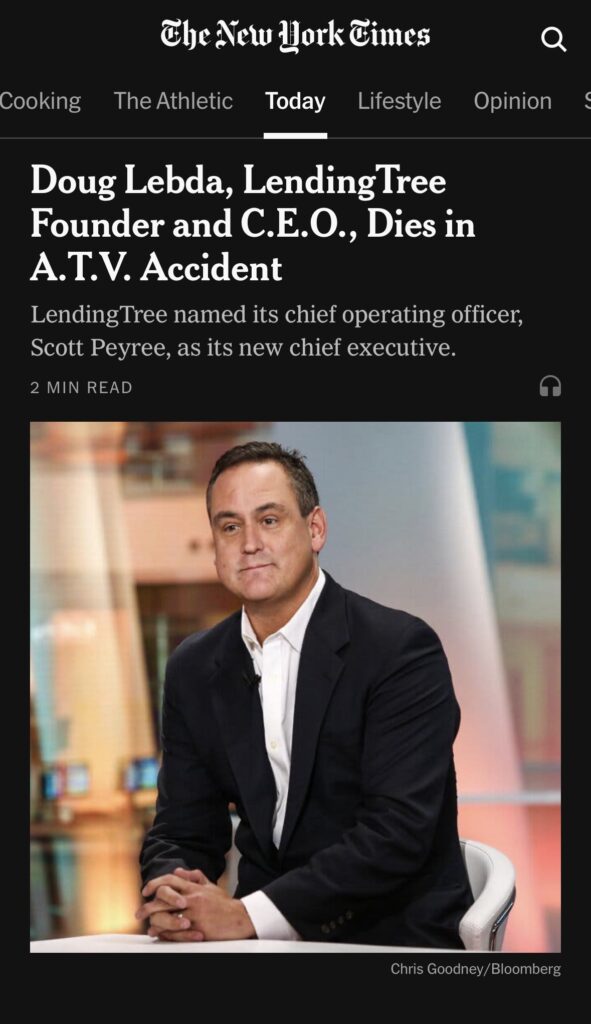
He was the founder and longtime CEO of the company. He was a multimillionaire and a vital part of the company’s leadership team. Yet the lede of the story implied how irreplaceable he was:
LendingTree named its chief operating officer, Scott Peyree, as its new chief.
So yes, folks, even the most important of corporate officers can be replaced mere hours after an accident. It reminds me that the most important things in life happen not at work (where you can be replaced at will) but at home and with your family. I doubt that his wife has already named his replacement.
-
Tuesday Links (Oct. 7)
- WSJ: OpenAI, AMD Announce Massive Computing Deal, Marking New Phase of AI Boom (Oct 6, 2025)
OpenAI to purchase 6GW of AMD chips and take up to 10% equity stake in AMD, a huge win for AMD as they battle dominant AI chipmaker, Nvidia. - WSJ: Anthropic and IBM Partner in Bid for AI Business Customers (Oct 7, 2025)
Anthropic and IBM are partnering to integrate Anthropic’s Claude AI models into IBM’s software. “Kareem Yusuf, IBM’s senior vice president of ecosystem and strategic partners, said the Armonk, N.Y.-based company initiated the partnership after seeing how well Anthropic’s models performed on its own benchmarks, and recognizing they shared a focus on corporate customers.” - NY Times: Recruiters Use A.I. to Scan Résumés. Applicants Are Trying to Trick It. (Oct 7, 2025)
Job seekers are increasingly using hidden instructions in their résumés to manipulate AI screening tools, as “[R]oughly 90 percent of employers now use A.I. to filter or rank résumés.” - NY Times: Elon Musk Gambles on Sexy A.I. Companions (Oct 6, 2025)
xAI launched two sexually explicit chatbots to engage users with increasingly raunchy content as they progress through conversation levels. What could go wrong with this!? - Axios: The biggest sign yet of an AI bubble is starting to appear (Oct 3, 2025)
AI tech companies are leveraging debt, sometimes hidden through private lenders and special purpose vehicles, to fund their AI infrastructure buildout. - NY Times: We Finally Have Free Anti-Robocall Tools That Work (Oct 2, 2025)
iOS 26 features a new call screening technology by using AI tools to ask the caller their name and the reason for the call. I enabled this personally last week. Zero robocallers since then.
- WSJ: OpenAI, AMD Announce Massive Computing Deal, Marking New Phase of AI Boom (Oct 6, 2025)
-
AI Pricing Trends
When Disney launched Disney+ in 2020, it came to market with a really low price: $6.99 per month. The strategy was obvious—use a bargain price to quickly build a subscriber base and compete with Netflix.
It worked. Families eagerly added Disney+ to their lineup of streaming services, drawn by its deep library of shows and movies. But as the platform grew, investors started pushing Disney to make the service profitable. Over the next few years, Disney steadily raised prices. Today, the ad-free tier costs nearly three times what it did at launch.
This story isn’t just about streaming. It’s a preview of what’s coming with AI services.
⸻
The $20 Benchmark for AI
When OpenAI launched ChatGPT Plus at $20 a month, it wasn’t the product of intricate economic modeling. Instead, it reflected an attempt to recoup some of the enormous costs behind the scenes—training models, running massive server farms, and paying world-class researchers.
That $20 price point quickly became the de facto benchmark for consumer-facing AI tools, with Anthropic and others adopting similar rates.
But OpenAI has been clear that its ambitions go far beyond the current offering. Its Stargate initiative involves building massive infrastructure, partnering globally, and spending billions on data centers. At some point, investor money won’t be enough—they’ll need sustainable revenue.
And just like Disney, the path is clear: grow the subscriber base, then gradually raise prices once users view the product as indispensable.
⸻
The Coming Price Climb
Right now, $20 a month feels reasonable. But look ahead 5–10 years. As AI capabilities expand, it’s easy to imagine prices climbing to $50, $60, or even $100 per month.
For individual consumers, that may be tough to swallow. A household with multiple subscriptions could find itself spending several hundred dollars a month on AI tools.
For businesses, however, the math looks different. If AI can make an employee just 10% more productive, the return on investment is obvious. An employee earning $60,000 annually who produces the equivalent of $66,000 in value thanks to AI easily justifies a $100 subscription. For programmers or knowledge workers achieving productivity gains of 50% or more, companies might begrudgingly pay hundreds—even thousands—per employee, per month.
The economics are compelling, and the pressure to raise prices is certain.
⸻
AI-Adjacent Tools Will Follow
This dynamic won’t be limited to large language models. AI-adjacent tools—platforms like Jira or Siteimprove—are racing to integrate AI features into their products. The added capabilities will deepen customer reliance. But once the early adoption phase passes, I expect these vendors to raise prices as well.
It’s the same playbook: demonstrate new value, increase lock-in, then adjust pricing upward.
⸻
The Staffing Equation
All of this has implications beyond budgets. If AI makes employees 50% more efficient, organizations will rethink staffing structures. Efficiency gains don’t automatically translate into cost savings unless roles are consolidated or organizations grow.
Take three departments, each with a similar role. If AI tools boost each person’s productivity by 50%, the organization suddenly has capacity for 4.5 units of work when only three are needed. The logical response is to reduce headcount—perhaps to two positions covering all three departments. But that requires some degree of centralization to realize these gains. Better options include company growth or redeploying personnel in areas of need or opportunity. There will be disruption of the workforce, but it doesn’t have to lead to layoffs.
⸻
Planning for the Future
The lesson from Disney+ is clear: early low prices are temporary. AI services are following the same trajectory, and organizations should prepare now.
- Expect rising subscription costs—both for core AI platforms and for AI-enhanced tools.
- Budget for increases of 50% or more annually over the next few years.
- Plan staffing structures to capture the efficiency gains AI makes possible. I’m sure companies will prefer growth and redeployment, but that’s not always assured.
AI will reshape productivity in profound ways. But as with streaming, the honeymoon pricing phase won’t last forever.
-
AI Free Agency
From the Wall Street Journal: Mark Zuckerberg Announces New Meta ‘Superintelligence Labs’ Unit and a partial reorganization of Meta.
Mark Zuckerberg announced a new “Superintelligence” division within Meta Platforms, officially organizing an effort that has been the subject of an intense recruiting blitz in recent months.
Former Scale CEO Alexandr Wang will lead the team as chief AI officer, and former GitHub CEO Nat Friedman will lead the company’s work on AI products, according to an internal memo Zuckerberg sent to employees that was viewed by The Wall Street Journal.
This after another WSJ article last week about “the list”, designed to ameliorate Meta’s recent disappointing Llama work.
All over Silicon Valley, the brightest minds in AI are buzzing about “The List,” a compilation of the most talented engineers and researchers in artificial intelligence that Mark Zuckerberg has spent months putting together.
Facebooks’ pivot from virtual reality / metaverse (Facebook -> Meta) to AI suggests that the metaverse was the wrong bet. I suspect Zuckerberg knows it, too, but this huge spending spree aligns with Zuck’s ethos, move fast and break things.
In a world where a really good basketball player (Shai Gilgeous-Alexander) can command $285 million over four years, spending upwards of $100 million per transformative engineer seems like a relative bargain.
-
If AI Lets Us Do More in Less Time—Why Not Shorten the Workweek?
It’s a good question for work (particularly for white collar roles) — if workers are more productive because of AI, should the workweek be shorter?
This question is increasingly central to debates about the future of work and closely tied to the growing interest in the four-day workweek. According to Convictional CEO Roger Kirkness, his team was able to shift to a 32-hour schedule without any pay cuts—thanks to AI. As he told his staff, “Fridays are now considered days off.” The reaction was enthusiastic. “Oh my God, I was so happy,” said engineer Nick Wechner, who noted how much more quickly he could work using AI tools.
Aside from his contention for boss of the year award, Kirkness recognizes the key criteria for success: getting your work done. If the work can be done faster, companies can choose: (1) reduce the total number of hours worked per employee (without reducing headcount); (2) reduce headcount by a commensurate number (in Convictional’s case, 20%); (3) grow the company to do more work with a similar number of employees.
As a worker, I’m sympathetic to the idea of shorter work weeks, but I suspect that growth is a more realistic option. Employees continue to work similar hours, but increased productivity leads to company growth (but not headcount growth).
-
Politico: Artificial intelligence threatens to raid the water reserves of Europe’s driest regions
Amazon and Microsoft are considering building data centers in Aragon (northeastern Spain), a prospect that some in Europe are concerned about because of water use.
This is an extension of an ongoing conversation in the EU:
Much has been written about A.I.’s energy demand and carbon footprint. But running a data center is also extremely thirsty work. In 2024, Europe’s data center industry consumed about 62 million cubic meters of water, which is equivalent to about 24,000 Olympic swimming pools.
After reading this, I thought, geez, that’s a lot of water. But when converting this to acre-feet, it’s roughly 50,000 acre-feet. A large number, for sure, but not astronomically large. By comparison, Granger Lake in Texas stores roughly the same amount of water.
In 2022, total water usage in Texas eclipsed 15 million acre-feet, of which approximately 7.5 million acre-feet were consumed by irrigation. This makes the 50,000 figure from Europe seem negligible for an population of 450 million.